
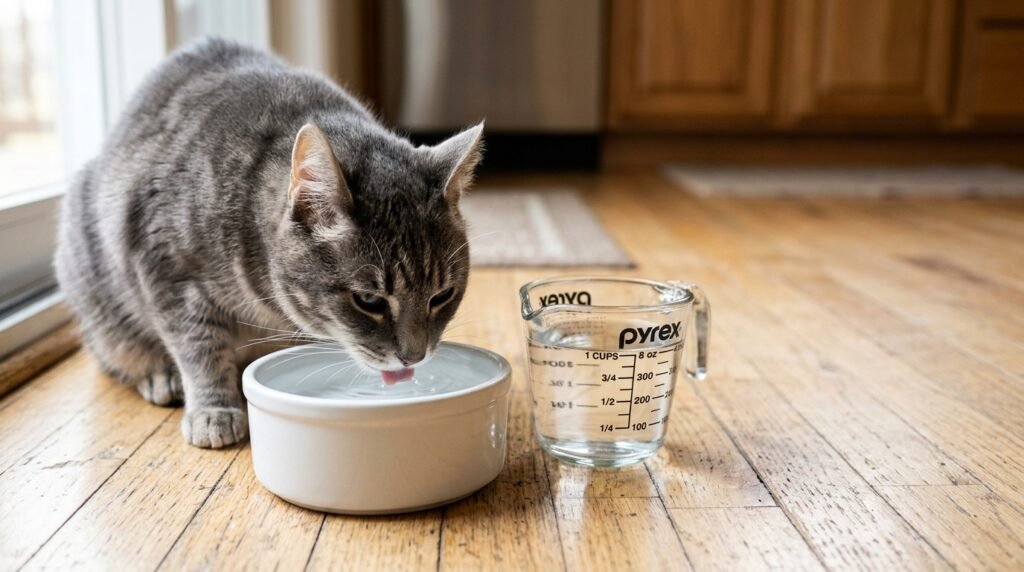
If your cat has started camping out at the water bowl, emptying it before evening, or leaving litter clumps twice the size they used to be, that change is worth taking seriously. Increased thirst is one of the earliest signs of kidney disease in cats, and it often shows up months before weight loss or a poor appetite. It can also point to diabetes, an overactive thyroid, or a urinary infection, which is why guessing at home rarely gets you a clear answer. If you have been searching for a cat vet near me because of a thirsty older cat, this guide from Del Paso Veterinary Clinic in North Sacramento explains what normal drinking looks like, which warning signs matter, what else vets rule out, and how a short diagnostic workup gets you real answers.
How Much Water Should a Cat Drink in a Day?
Most healthy adult cats take in roughly 40 to 60 milliliters of water per kilogram of body weight each day, and that total includes the moisture in their food. The range is wide for a reason. Canned food is about three quarters water, so a cat on a wet diet may barely visit the bowl. A cat on dry kibble has to drink almost all of it.
Veterinarians generally treat intake above 100 mL per kilogram per day as excessive. The medical term is polydipsia. It almost always travels with polyuria, which simply means producing more urine, and vets often shorten the pair to PU/PD.
Daily Water Guide by Body Weight
| Cat’s Weight | Typical Daily Water (Food + Bowl) | Considered Excessive Above |
|---|---|---|
| 6 lb (2.7 kg) | about 110 to 165 mL (4 to 5.5 oz) | about 270 mL (just over 1 cup) |
| 8 lb (3.6 kg) | about 145 to 220 mL (5 to 7.5 oz) | about 365 mL (1.5 cups) |
| 10 lb (4.5 kg) | about 180 to 270 mL (6 to 9 oz) | about 455 mL (just under 2 cups) |
| 12 lb (5.4 kg) | about 220 to 325 mL (7.5 to 11 oz) | about 545 mL (2.3 cups) |
| 15 lb (6.8 kg) | about 270 to 410 mL (9 to 14 oz) | about 680 mL (nearly 3 cups) |
Change matters more than the exact number. A cat who used to sip a few ounces a day and now finishes a full bowl is telling you something, even if it is still under the line.
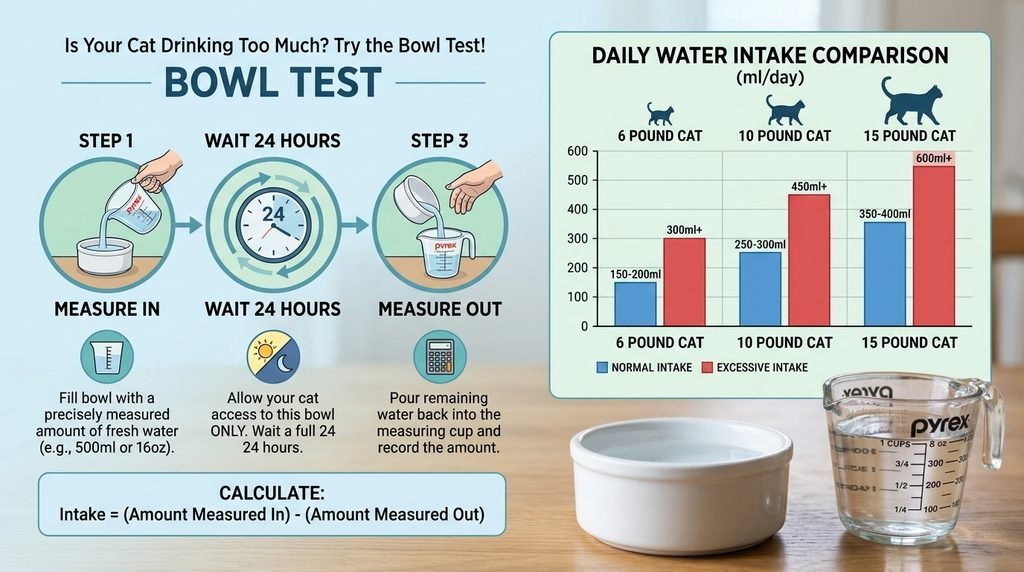
How to Measure Your Cat’s Water Intake at Home
- Use one bowl and fill it with a measured amount from a kitchen measuring cup.
- Measure what is left 24 hours later. The difference is roughly what your cat drank.
- Repeat for three days. One thirsty afternoon means little. A steady upward trend means a lot.
- Note the food type. Wet, dry, or mixed makes a big difference, and your vet will ask.
In multi-cat homes, watch the litter box instead. Bigger clumps or more frequent scooping mean the kidneys are passing more water, whether or not you see anyone drinking.
Signs of Kidney Disease in Cats to Watch For
Kidney disease rarely announces itself. Cats compensate well, and the early changes are easy to write off as normal aging. The Cornell Feline Health Center notes that cats in the early stages often show no obvious signs at all, because the remaining kidney tissue picks up the slack. Cornell also points out that age is the only known risk factor, which is why senior cats need regular monitoring.
Early Cat Kidney Disease Symptoms
Most early kidney disease in cats symptoms are behavioral rather than dramatic:
- Drinking more. Often the very first change owners notice.
- Larger or more frequent litter clumps. Dilute urine means more volume.
- Urinating outside the box. Sometimes the box simply fills faster than it used to.
- Gradual weight loss. Feel along the spine and hips. A cat who went from 11 pounds to 10 pounds has lost about 9 percent of its body weight.
- Pickier appetite. Eating some meals, skipping others, or preferring treats.
- A dull or scruffy coat. Cats who feel unwell groom less.
Later Signs of Kidney Failure in Cats
As the disease advances, waste products build up in the blood and the signs become harder to miss:
- Vomiting, sometimes clear fluid or foam
- Breath with an ammonia or urine-like smell
- Mouth ulcers and drooling
- Constipation from ongoing dehydration
- Lethargy, hiding, and sleeping more
- Muscle wasting, especially over the back and hind legs
- Sudden vision loss caused by high blood pressure
By the time these show up, a large share of kidney function is usually already gone. A large UK primary care study from VetCompass found that about two thirds of cats already had clinical signs when their kidney disease was diagnosed, and that it was the most common cause of death in cats over five years old.
Understanding Chronic Kidney Disease in Cats
Chronic kidney disease in cats, usually shortened to CKD, is a slow and permanent loss of working kidney tissue. Healthy kidneys filter waste, concentrate urine, balance potassium and phosphorus, help control blood pressure, and trigger red blood cell production. The first job to fail is usually concentrating urine. Water leaves the body as dilute urine and the cat drinks more to keep up, which is exactly why thirst is such an early clue.
It is also very common. A 2025 review published in the journal Life estimated that CKD affects 20 to 50 percent of cats over 10 years of age, with prevalence climbing further as cats reach their mid-teens.
Chronic Kidney Disease vs Acute Kidney Failure in Cats
| Feature | Chronic Kidney Disease | Acute Kidney Injury |
|---|---|---|
| Onset | Months to years | Hours to days |
| Common causes | Aging, inherited polycystic kidney disease, past kidney damage | Lily or antifreeze poisoning, urinary blockage, severe infection, some medications |
| Thirst pattern | Rises gradually | May spike, or the cat may stop drinking entirely |
| Reversible? | No, but often manageable for years | Sometimes, with fast treatment |
| How soon to see a vet | Book an exam within days | Same day, treat as an emergency |
Lilies deserve a special warning. Every part of true lilies and daylilies, including the pollen and the water in the vase, can cause acute kidney failure in cats. If you think your cat has chewed a lily or licked antifreeze, call your vet or the ASPCA Animal Poison Control Center right away.
What Else Could Make a Cat Drink So Much Water?
Kidney disease is the most frequent reason an older cat becomes thirsty, but it shares the spotlight with two other conditions that vets often call the big three.
Diabetes Mellitus
When blood sugar runs too high, glucose spills into the urine and pulls water out with it. The classic picture is a cat that drinks heavily, eats eagerly, and still loses weight. Overweight indoor cats carry a higher risk. Some diabetic cats also start walking flat on their hocks, a sign of nerve damage in the back legs.
Hyperthyroidism
A benign growth on the thyroid gland pushes hormone levels up and speeds up the whole body. These cats are often ravenous yet thin, restless, and vocal at night, with a racing heart rate. Most are over 10. There is an important twist here: an overactive thyroid increases blood flow to the kidneys and can hide existing kidney disease. Once the thyroid is treated, kidney values sometimes rise, so vets usually recheck them after treatment starts.
Urinary Tract and Kidney Infections
Bacterial bladder infections are uncommon in young cats but show up more often in seniors, particularly those with CKD or diabetes, because dilute urine offers less natural protection. An infection that travels up to the kidneys, called pyelonephritis, can cause fever, back discomfort, and increased thirst.
Other Medical Causes
Less common culprits include liver disease, high blood calcium, low potassium, pyometra in unspayed females, certain cancers, and medications such as steroids or diuretics.
Harmless Reasons for Extra Drinking
Not every thirsty cat is sick. A switch from wet food to dry kibble, a hot Sacramento summer in a home without air conditioning, extra play, recovery from a bout of vomiting, or a new fountain your cat likes can all raise intake. These usually settle within a day or two. If the change lasts longer with no obvious explanation, schedule a checkup.
The Big Three at a Glance
| Clue | Kidney Disease | Diabetes | Hyperthyroidism |
|---|---|---|---|
| Thirst and urination | Increased | Often markedly increased | Increased |
| Appetite | Declines over time | Increased | Strongly increased |
| Weight | Gradual loss | Loss | Loss despite eating well |
| Energy and behavior | Quieter, sleeps more | Variable, may show hind leg weakness | Restless, vocal, hyperactive |
| Typical patient | Senior cats | Middle-aged, often overweight | Usually over 10 |
| Key test | Creatinine, SDMA, urine concentration | Blood and urine glucose, fructosamine | Total T4 |
How Vets Tell These Conditions Apart
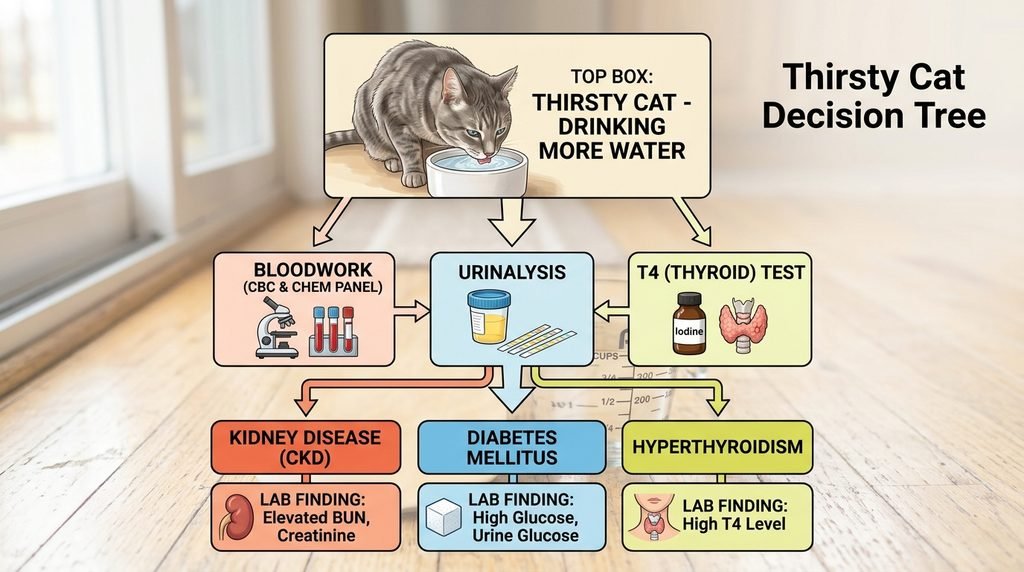
One visit with a focused set of tests answers most of the question. Our pet diagnostic services start with a physical exam, a weight comparison against past visits, and palpation of the kidneys and thyroid area, followed by the core workup below.
Bloodwork
A complete blood count looks for anemia, which is common in CKD, along with signs of infection. A chemistry panel measures creatinine and BUN (the main kidney waste markers), phosphorus, potassium, glucose, calcium, and liver values. Because this bloodwork runs in our in-house lab, results are often ready within an hour or two.
Urinalysis
Urine specific gravity shows how well the kidneys concentrate. Healthy cat urine is very concentrated, so dilute urine combined with rising kidney values points strongly toward CKD. The same sample is checked for glucose, protein, and bacteria. Urinalysis goes to a reference lab, with results typically back in one to three days.
Thyroid Testing
A total T4 blood test screens for hyperthyroidism. For any thirsty cat over seven, it belongs in the first round of tests, because an overactive thyroid can hide kidney disease.
Imaging
Digital X-rays and ultrasound show kidney size and shape, along with stones, cysts, or masses. Small, irregular kidneys suggest long-standing CKD. Our guide to in-house veterinary diagnostics explains what to expect on the day.
Understanding IRIS Staging
Once CKD is confirmed in a stable, well-hydrated cat, vets stage it using the system published by the International Renal Interest Society. Staging guides treatment and helps set realistic expectations.
| IRIS Stage | Creatinine (mg/dL) | SDMA (µg/dL) | What You Might Notice |
|---|---|---|---|
| Stage 1 | Under 1.6 | Under 18 | Usually nothing |
| Stage 2 | 1.6 to 2.8 | 18 to 25 | Mild thirst, slight weight loss |
| Stage 3 | 2.9 to 5.0 | 26 to 38 | Clear thirst, appetite and weight changes, occasional vomiting |
| Stage 4 | Over 5.0 | Over 38 | Significant illness, nausea, dehydration |
SDMA is a newer marker that, in cats that go on to develop CKD, rises above normal a median of about 17 months before creatinine does, so your vet may suggest adding it. For the advanced end of the scale, our guide to end stage kidney disease in cats covers Stage 4 care and quality of life decisions.
Case Study: What a Typical Thirst Workup Looks Like
The example below is a composite based on how these cases commonly unfold in general practice. It does not describe a specific patient.
The concern: A 13-year-old indoor cat on mostly dry food. The water bowl was empty by evening, litter clumps had roughly doubled over two months, and the cat had lost about a pound in a year.
The exam: Mild dehydration, small firm kidneys on palpation, and slight muscle loss along the spine.
The results:
- Same-day bloodwork showed creatinine mildly elevated at 2.3 mg/dL, with normal glucose and high-normal phosphorus
- Urine was dilute at a specific gravity of 1.018, with no glucose and no bacteria
- Total T4 came back normal
The diagnosis: IRIS Stage 2 chronic kidney disease.
The plan: A gradual switch to a prescription kidney diet, more wet food in rotation, a water fountain plus a second bowl, and a recheck of bloodwork, urine protein, and blood pressure in three months.
The takeaway: Because the owner noticed the water bowl early, treatment started at Stage 2 instead of Stage 3 or 4, a point from which many cats live comfortably for years.
When Increased Thirst Becomes an Emergency
Most thirsty cats need a prompt appointment, not an emergency visit. These situations cannot wait:
- Straining in the litter box with little or no urine, especially in male cats, which can mean a life-threatening blockage
- Not eating for a full day, which can trigger serious liver complications
- Repeated vomiting or being unable to keep water down
- Suspected lily or antifreeze exposure
- Sudden weakness, collapse, or blindness
If you are looking for an urgent care vet near me in North Sacramento, call us first so the team can prepare for your arrival. Outside of clinic hours, go directly to the nearest 24-hour emergency hospital.
What Happens After a Kidney Disease Diagnosis
A CKD diagnosis is not a countdown. It is the start of a management plan, and many cats do well on one for a long time.
Diet Changes
Prescription kidney diets restrict phosphorus and adjust protein, easing the workload on the remaining kidney tissue. Cornell describes diet change as a proven part of CKD treatment and usually the first step. Switch gradually over a week or two, since cats can form food aversions if a new diet arrives while they feel nauseous.
Hydration and Medication
- Offer wet food daily and place water bowls or a fountain in several rooms
- In later stages, your vet may teach you to give subcutaneous fluids at home
- Depending on lab results, treatment may add phosphate binders, blood pressure medication, anti-nausea drugs, appetite stimulants, or potassium
Regular Monitoring
Kidney values, blood pressure, urine protein, and body weight are rechecked every three to six months, depending on how stable your cat is. A senior pet vet who tracks these numbers over time can spot a shift before your cat feels it.
Dental Health Matters Too
Bad breath in an older cat can come from kidney waste or dental disease, and painful teeth make eating harder for a cat that already has a fragile appetite. If you notice tartar, red gums, or dropped food, see a cat dentist near me; anesthesia can be adjusted for reduced kidney function.
How Often Should Older Cats Get Kidney Screening?
| Life Stage | Age | Suggested Screening |
|---|---|---|
| Young adult | 1 to 6 years | Annual exam, with baseline bloodwork by middle age |
| Mature | 7 to 10 years | Annual exam with bloodwork, urinalysis, and T4 |
| Senior | 10+ years | Exam and lab work every 6 months |
| Diagnosed CKD | Any age | Every 3 to 6 months, or as your vet directs |
A creatinine level that creeps up within the normal range over two years tells your vet far more than one number on one day. That is the real value of a routine pet wellness exam: it builds the history that makes early detection possible.
Bring Your Thirsty Cat to Del Paso Veterinary Clinic
Dr. Khabra brings 18 years of veterinary experience to every exam, and our in-house lab means most bloodwork answers arrive the same day. We see cats from Del Paso Heights, North Sacramento, Natomas, Arden-Arcade, West Sacramento, and surrounding neighborhoods.
Bring your water log, the name of your cat’s food, and a list of any medications. Call (916) 925-2107 or visit us at 924 Del Paso Blvd, Sacramento, CA 95815 to book with a trusted cat vet in Sacramento.
Frequently Asked Questions
-
How much water is too much for a cat?
Most veterinarians consider more than 100 mL per kilogram of body weight per day to be excessive. For a 10-pound cat, that works out to a little under two cups daily. The number matters less than the trend, though. If your cat is drinking noticeably more than usual for several days in a row, and the weather, diet, or activity level has not changed, it is time to book an exam and basic lab work.
-
Can kidney disease in cats be reversed?
Chronic kidney disease cannot be reversed, because the damaged tissue does not regenerate. It can, however, often be slowed considerably with diet changes, hydration support, and medication. Acute kidney injury is different. When caught quickly, such as after lily exposure or a urinary blockage, some cats recover meaningful kidney function with aggressive hospital treatment. This is why sudden changes always deserve a same-day phone call to your vet.
-
What are the first signs of kidney failure in cats?
The earliest signs of kidney failure in cats are usually increased thirst and larger, more frequent urine clumps in the litter box. Gradual weight loss, a pickier appetite, and a duller coat often follow. Vomiting, ammonia-smelling breath, and lethargy tend to appear later, once more kidney function has been lost. Because early changes are subtle, routine bloodwork for cats over seven catches many cases before symptoms appear at all.
-
How is chronic kidney disease in cats diagnosed?
Vets diagnose chronic kidney disease in cats with a combination of bloodwork and urinalysis. Blood tests measure creatinine, BUN, and phosphorus, while urine specific gravity shows whether the kidneys can still concentrate. Many vets also check SDMA, thyroid levels, blood pressure, and urine protein. Imaging such as X-rays or ultrasound may be added to assess kidney size and structure. The diagnosis is confirmed when abnormal values persist in a stable, hydrated cat.
-
Should I limit water if my cat urinates too much?
No. Never restrict water for a cat with increased thirst or urination. The extra drinking is the body compensating for urine it can no longer concentrate. Taking water away can quickly lead to dangerous dehydration, especially in a cat with kidney disease. Instead, keep fresh water available in several places, add wet food to the diet, and talk to your vet about finding and treating the underlying cause.
-
How long can a cat live with kidney disease?
Survival depends heavily on the stage at diagnosis and how well the cat responds to treatment. Cats diagnosed at Stage 1 or 2 often live for several years with good quality of life, and some pass away from unrelated age-related conditions. Cats diagnosed at Stage 3 or 4 generally have a shorter outlook, measured in months to a few years. Consistent monitoring and early adjustments to treatment make a real difference at every stage.
A thirsty cat is often a cat asking for help in the only way it can, and a quick look at the water bowl today could add years to your time together.