

Caring for a cat in the final stage of kidney disease is exhausting in a way few people talk about. You are watching food bowls, counting good days, and wondering whether you are seeing the end or just another rough patch. End stage kidney disease in cats does follow recognizable patterns, though, and knowing them helps you make calm, kind decisions instead of rushed ones. This guide from Del Paso Veterinary Clinic, a veterinarian near me option for families across North Sacramento, explains the physical and behavioral signs of the last stage, what a realistic timeline looks like, how to keep your cat comfortable, and how to recognize when it may be time to say goodbye.
What End Stage Kidney Disease in Cats Actually Means
Veterinarians use the International Renal Interest Society (IRIS) system to stage chronic kidney disease from 1 to 4. End stage feline kidney disease generally refers to Stage 4, when blood creatinine sits above 5.0 mg/dL and only a small fraction of kidney function remains. At this point the kidneys can no longer clear waste from the blood, and those toxins, collectively called uremia, start affecting the stomach, mouth, brain, muscles, and blood. Vet records and online resources may call the same phase feline end stage renal failure or feline kidney failure end stage; the terms describe the same final chapter of the disease.
If your cat was recently staged, our guide to stage 4 kidney disease in cats covers the lab values and medical management in detail. This article focuses on what comes next: recognizing decline, keeping your cat comfortable, and preparing for the goodbye.
A Uremic Crisis Is Not Always the End
This point matters before any decision. A cat who arrives dehydrated and vomiting can have kidney values that look far worse than their true baseline. Veterinary proceedings published on dvm360 note that roughly 30 percent of cats presenting with creatinine above 5 mg/dL move into a lower IRIS stage once they are rehydrated and stabilized. If your cat has had a sudden crash and has not yet had fluid therapy, ask your vet whether a short trial of treatment makes sense before deciding.
| Situation | What It Looks Like | Outlook |
|---|---|---|
| Uremic crisis on top of CKD | Sudden vomiting, dehydration, refusing food after a stable period | Some cats rebound with IV or subcutaneous fluids |
| True end stage renal disease in cats | Steady decline despite treatment, values stay high after rehydration | Comfort becomes the main goal |
What Are the Symptoms of a Cat Dying of Kidney Failure?
The signs below usually build over weeks, not hours. Many families notice several at once.
Physical Signs
- Little or no appetite, even for favorite foods or treats
- Severe weight and muscle loss, with the spine and hip bones easy to feel
- Frequent vomiting or drooling from nausea
- Breath with a strong ammonia or metallic smell
- Mouth ulcers on the gums or tongue that make eating painful
- Pale gums from anemia, since failing kidneys stop signaling red blood cell production
- Dehydration even while drinking, with sunken eyes and skin that tents when gently lifted
- Constipation or, in some cats, dark tarry stool from stomach ulcers
Behavioral Signs
- Hiding in closets or under beds
- Sitting hunched with the head low, often near the water bowl
- No longer grooming, leaving the coat greasy, matted, or spiky
- Urinating or defecating outside the litter box
- Losing interest in people, play, sunny spots, and other pets
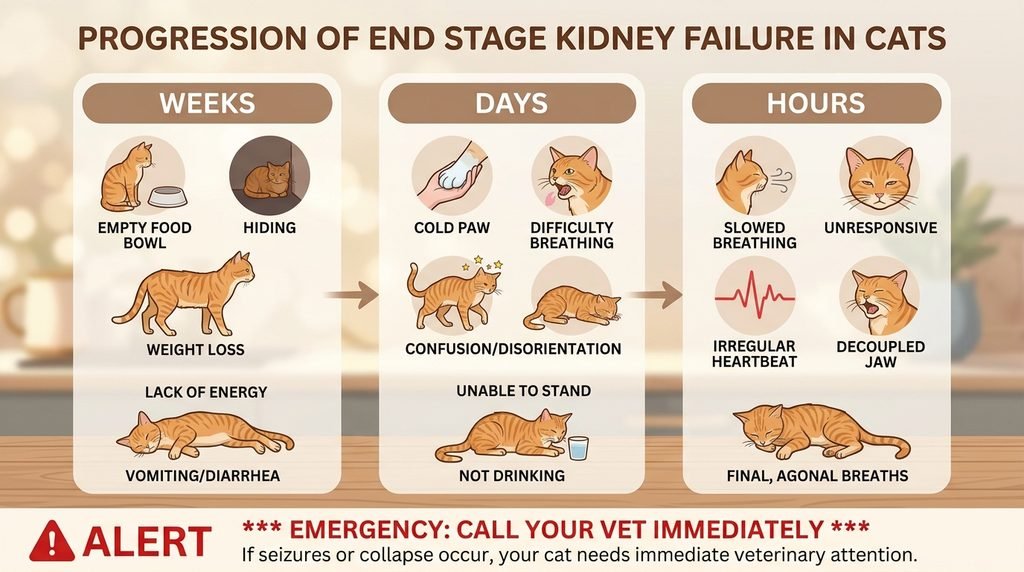
Signs in the Final Days or Hours
When feline kidney failure reaches its very end stage, the body begins to shut down:
- Unable to stand or walk steadily
- Cold ears, paws, and a low body temperature
- Changes in breathing, including open-mouth or labored breaths
- Muscle twitching, tremors, or seizures
- Little response to touch, voice, or surroundings
- Complete refusal of food and water
If you see seizures, collapse, or labored breathing, call your veterinarian right away rather than waiting to see if it passes.
End Stage Kidney Failure in Cats: A Realistic Timeline
No vet can give an exact countdown, but published data offers useful context. In a well-known study of 211 cats by Boyd and colleagues, cats diagnosed at IRIS Stage 4 had a median survival of about 103 days, compared with 778 days for Stage 3. “Median” means half lived shorter and half lived longer, and some Stage 4 cats lived well over a year with treatment.
| Phase | What You May See | Typical Length |
|---|---|---|
| Managed Stage 4 | Eating with help, needs fluids and anti-nausea medication, still enjoys some routines | Weeks to several months |
| Declining | Appetite fading despite medication, more hiding, weight dropping quickly | Days to a few weeks |
| Final phase | Refusing food and water, weakness, low temperature, minimal response | Hours to a few days |
The speed of decline depends on how your cat responds to fluids, whether high blood pressure or anemia is controlled, other conditions like hyperthyroidism or heart disease, and plain individual resilience.
Is Kidney Failure Painful for Cats?
Kidney failure is not usually painful in the way a broken bone is, but it causes real suffering. Uremic toxins create persistent nausea, mouth ulcers sting with every bite, and dehydration leaves cats feeling weak and unwell. Cats also hide discomfort extremely well.
Watch for these signs that your cat is hurting or feeling sick:
- A hunched posture with the belly tucked up
- Squinted eyes and a tense face
- Lip licking, drooling, or approaching food and then walking away
- Reluctance to jump, climb, or be picked up
- Growling or hissing when touched, especially out of character
Good palliative care can ease much of this, which is why regular rechecks remain valuable even late in the disease.
Comfort Care in the Final Weeks
When the goal shifts from slowing the disease to keeping your cat comfortable, the plan changes too.
Medical Comfort Support
- Subcutaneous fluids at home to ease dehydration, which many cats tolerate well
- Anti-nausea medication to make eating possible
- Appetite stimulants, including options applied to the ear
- Antacids to protect a stomach irritated by uremic toxins
- Pain relief chosen with the kidneys in mind
Making Home Easier
- Move food, water, and a low-sided litter box close to your cat’s favorite resting spot
- Provide a warm bed or a heated pad set to low, since failing kidneys make cats feel cold
- Keep the house quiet and routines predictable
- Gently brush or wipe the coat if your cat has stopped grooming
Feeding at the End
Earlier in the disease, a prescription kidney diet is one of the most effective treatments. In the final weeks, eating anything matters more than eating the perfect food. Warm wet food slightly to boost the smell, offer small portions often, and ask your vet before switching. Never force-feed a cat who is nauseous, because it can create food aversion and stress.
Families who started managing a cat’s aging needs early often find this stage easier to navigate. Our guide to senior pet care explains how to prepare for these changes ahead of time.
Kidney Disease in Cats: When to Euthanize
This is the hardest question, and there is rarely one perfect day. Many veterinarians say it is kinder to choose a week too early than a day too late. The AAHA/IAAHPC End-of-Life Care Guidelines describe end of life as a distinct final life stage, where comfort and dignity become the main goals of care.
Questions to Ask Yourself
- Is my cat still eating enough to maintain some energy, even with medication?
- Does my cat still greet me, seek out favorite spots, or show interest in anything?
- Are vomiting and nausea controlled most of the time?
- Can my cat get to the litter box and stay reasonably clean?
- Are bad days now outnumbering good days?
At Del Paso, quality of life consultations use the “Five H’s”: hurt, hunger, hydration, hygiene, and happiness, along with mobility and breathing. Our full guide to end of life pet care walks through the longer HHHHHMM scale many families find helpful.
Track Good Days and Bad Days
A simple calendar can make a blurry situation clearer. Mark each day with a check for a good day or an X for a bad day. When the X marks clearly outnumber the checks over a week or two, it is time for a serious conversation with your veterinarian.
| Sign | Still Comfortable | Time to Talk With Your Vet |
|---|---|---|
| Appetite | Eats with help or medication | Refuses food for more than a day or two |
| Nausea | Controlled most days | Vomiting despite medication |
| Mobility | Moves to favorite spots | Struggles to stand or reach the litter box |
| Engagement | Seeks attention, responds to you | Hides constantly, little response |
| Hygiene | Mostly clean | Soiling itself, unable to groom |
Case Study: How a Family Reached the Decision
The example below is a composite based on how these situations commonly unfold in general practice. It does not describe a specific patient.
Background: A 17-year-old cat with CKD managed for three years moved into Stage 4 over the winter. Home fluids and anti-nausea medication kept the cat eating for about two months.
The turning point: Over ten days, appetite dropped to a few bites a day despite an appetite stimulant. The cat stopped sleeping on the family’s bed and began hiding behind the couch. The family’s calendar showed seven bad days out of the last ten.
The visit: A quality of life exam confirmed significant weight loss, dehydration, and mouth ulcers. Bloodwork showed kidney values had climbed further despite fluids. The veterinarian explained that additional treatment could extend time but was unlikely to restore comfort.
The outcome: The family scheduled a quiet appointment two days later, gave favorite treats in the meantime, and stayed with their cat throughout. They chose private cremation and kept a paw print.
The takeaway: Tracking good and bad days gave this family a clear picture, so the decision felt planned rather than forced by an emergency.
What to Expect at a Euthanasia Appointment
Del Paso performs euthanasia at the clinic, where the team can provide a calm and controlled setting. If you are searching for cat euthanasia near me, here is what the process looks like:
- Choosing a quiet time. You can ask for a slower part of the day so the room is calm.
- Sedation first. A sedative is recommended so your cat is relaxed and unaware before the final injection.
- Your choice to be present. Family members can stay or step out, and other pets can come to say goodbye.
- No rush. You can stay with your cat for as long as you need afterward.
- Memories. Families are welcome to take photos or paw prints before the appointment.
Aftercare Options
| Option | How It Works | Ashes Returned? |
|---|---|---|
| Private cremation | Your cat is cremated individually through a partner provider | Yes, in an urn |
| Communal cremation | Your cat is cremated with other pets and ashes are scattered respectfully | No |
| Home burial | Our team offers guidance on doing this properly and legally | Not applicable |
Paw print keepsakes, fur clippings, and other memorial items may also be available through the cremation provider.
Grieving a Cat You Cared For Through Kidney Disease
Families of CKD cats often grieve twice: once while watching the decline, and again after the goodbye. Months of fluids, medications, and food bowl watching leave a gap that can feel surprisingly large. Guilt is common too, whether you wonder if you waited too long or acted too soon. Both feelings are normal. The Cornell Pet Loss Support Hotline is staffed by trained veterinary students and is open to anyone, and our team can connect you with local grief resources as well.
When to Call Right Away
Contact a vet the same day if your cat has a seizure, collapses, stops urinating, breathes with effort, or has not eaten or kept water down for a full day. If you need a same day vet near me in North Sacramento, call ahead so our team is ready. Outside of clinic hours, go to the nearest 24-hour emergency hospital. Families still in the earlier stages can review the signs of kidney disease in cats to understand how the disease progresses from the start.
Talk With Dr. Khabra About Your Cat’s Comfort
Dr. Khabra brings 18 years of veterinary experience to quality of life consultations, palliative care plans, and end-of-life appointments, and our team serves families from Del Paso Heights, North Sacramento, Natomas, Arden-Arcade, West Sacramento, and nearby neighborhoods. Call (916) 925-2107, visit us at 924 Del Paso Blvd, Sacramento, CA 95815, or contact our clinic to arrange a quiet time to talk.
Frequently Asked Questions
-
How long can a cat live with end stage kidney failure?
It varies widely. In a large published study, cats diagnosed at IRIS Stage 4 had a median survival of about three months, though some lived much longer with fluids, anti-nausea medication, and blood pressure control. Cats who stop responding to treatment may decline over days or a few weeks. Your veterinarian can give a more personal estimate based on bloodwork trends, appetite, and how well your cat tolerates home care.
-
Is kidney failure painful for cats?
End stage kidney failure causes nausea, mouth ulcers, dehydration, and weakness, all of which make cats feel genuinely unwell. Because cats hide discomfort, watch for a hunched posture, squinting, lip licking, hiding, and walking away from food. Anti-nausea drugs, antacids, fluids, and carefully chosen pain relief can ease much of this. If your cat seems uncomfortable despite treatment, that is an important sign to discuss quality of life with your vet.
-
Can a cat recover from end stage kidney failure?
Chronic kidney damage cannot be reversed, so a cat with true end stage kidney failure will not regain lost function. However, a cat in a sudden uremic crisis sometimes improves noticeably after fluid therapy, and its real baseline may turn out to be a lower stage. That is why vets often recommend a short trial of treatment and repeat bloodwork before making a final decision, unless the cat is clearly suffering.
-
Should I force-feed a cat with kidney failure?
Generally, no. Force-feeding a nauseous cat can cause stress, aspiration, and a lasting aversion to food. A better approach is treating the nausea first, then offering small portions of warmed, strongly scented wet food several times a day. Appetite stimulants can also help. Some families discuss a feeding tube with their vet earlier in the disease, but in the final stage, comfort usually takes priority over calorie targets.
-
How do I know when to euthanize a cat with kidney disease?
Look at the overall pattern rather than a single bad day. Ongoing refusal of food, vomiting despite medication, constant hiding, inability to reach the litter box, and more bad days than good are strong signals. Quality of life scales and a simple good-day and bad-day calendar make the picture clearer. Your veterinarian can examine your cat, review bloodwork trends, and help you decide with confidence rather than guilt.
-
Can I stay with my cat during euthanasia?
Yes. At Del Paso, family members are welcome to stay throughout, and you can also choose to step out if that feels better for you. A sedative is given first so your cat is relaxed and unaware. Other household pets may come to say goodbye, and you can stay with your cat for as long as you need afterward. Bringing a favorite blanket can make the room feel more familiar and calm.
Choosing comfort over more time is not giving up on your cat; it is the last and most loving form of care you can give.