
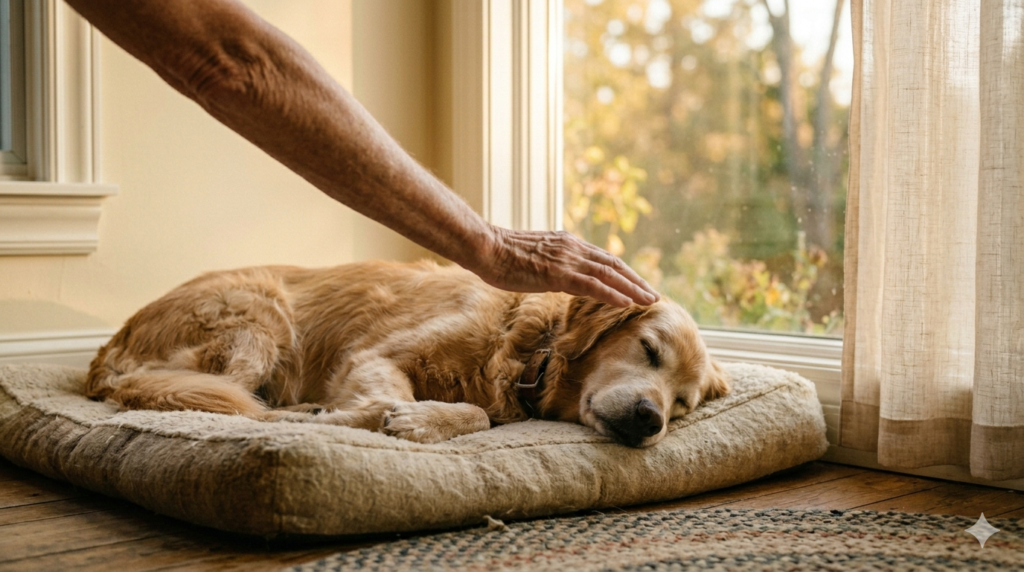
Few decisions weigh on a pet owner more heavily than the ones surrounding the final chapter of a beloved companion’s life. Whether you are watching your senior dog slow down on the daily walk you both used to love, or noticing your aging cat retreating to quiet corners of the house, this guide to end of life care for pets in Sacramento was written to help you navigate what comes next with clarity, comfort, and dignity. At Del Paso Veterinary Clinic, our team has walked this road with thousands of Sacramento families since 1940, and we believe no one should feel alone in it.
This guide covers how to assess your pet’s quality of life, what humane euthanasia actually involves, the cremation and aftercare choices available locally, and where to find real grief support afterward. It is honest where it needs to be, gentle where it should be, and grounded in the kind of practical detail Sacramento pet owners have told us they wish someone had explained sooner.
Quick stats from real Sacramento clients: Out of more than 200 end-of-life consultations our team handled in the past two years, the most common regret families shared was not the timing of euthanasia — it was waiting too long because they did not know what signs to look for. The information in this guide is meant to change that.
Recognizing When It Is Time: The Quality of Life Assessment
The hardest question in pet ownership is rarely the medical one. It is the human one: how do I know? Veterinary medicine has actually given us pretty good tools for this. The most widely used is a framework developed by Dr. Alice Villalobos called the HHHHHMM scale, which gives families a structured way to look at the whole pet rather than getting fixated on one symptom.
The HHHHHMM Quality of Life Scale
The seven letters stand for Hurt, Hunger, Hydration, Hygiene, Happiness, Mobility, and More good days than bad. Each one is scored on a 0–10 scale, and the total gives you a snapshot rather than a verdict.
- Hurt — Is pain controllable? Can your pet breathe comfortably?
- Hunger — Is your pet eating enough on their own, or do you have to coax every bite?
- Hydration — Is dehydration becoming a daily battle?
- Hygiene — Can your pet stay clean, or are accidents and matting becoming routine?
- Happiness — Does your pet still respond to favorite people, sounds, or smells?
- Mobility — Can your pet get up, move around, and reach the food and water bowl without help?
- More good days than bad — When the bad outnumber the good, the conversation has to start.
A consistent score below 35 out of 70 is generally the threshold where many veterinarians, including our team, will gently start the conversation about humane options.
Behavioral Signs Pet Owners Often Miss
Numbers help, but the soft signs matter just as much. We see the same patterns again and again in Sacramento families:
- A dog that stops greeting you at the door
- A cat that no longer grooms itself
- An animal that hides in unusual places, especially closets, under beds, or behind furniture
- Loss of interest in favorite toys, treats, or human company
- Restlessness through the night that no medication seems to ease
- Eyes that look distant, unfocused, or “checked out”
None of these alone is a death sentence. Together, especially over a stretch of weeks, they tell you something the lab work sometimes cannot.
Do Dogs Know When They Are Dying?
This is one of the most-searched questions Sacramento owners type into Google, and it deserves an honest answer. Dogs do not understand mortality the way humans do. They do, however, sense changes in their own bodies — pain, weakness, confusion — and many will respond by withdrawing, seeking solitude, or, conversely, becoming unusually clingy. They are not contemplating death. They are responding to discomfort. Knowing this can actually be reassuring: your dog is not afraid of dying. They are simply telling you they do not feel right.
For pets dealing with chronic conditions, our in-house diagnostics and lab work can give you and Dr. Khabra a same-day picture of what is happening internally, which makes quality-of-life conversations far more grounded.
What End of Life Care for Pets Actually Includes
End of life care is not a single appointment. It is a phase of medicine that begins long before the final visit, and it covers a much wider range of options than most owners realize.
Hospice and Palliative Care
Veterinary hospice is the same idea as human hospice: when curing the disease is no longer realistic, the focus shifts to comfort. This may include pain medication, anti-nausea drugs, appetite stimulants, fluid therapy, mobility aids, and home environment changes. The goal is not to extend life at any cost. The goal is to make the time that remains as good as it can be.
Pain Management at the End of Life
Untreated pain is the single biggest threat to quality of life in geriatric pets. Modern protocols often combine NSAIDs with adjunct medications like gabapentin and, in some cases, opioids. According to the American Animal Hospital Association’s pain management guidelines, multimodal pain control — using two or more drug classes together — is the current standard of care for chronic pain in older dogs and cats.
Comfort Care at Home
Small adjustments at home make a real difference. Orthopedic beds in warm spots away from drafts. Non-slip rugs or yoga mats over hardwood floors. Raised food and water bowls. Litter boxes with low entry sides for arthritic cats. A nightlight in the hallway for pets whose vision is fading. None of this is dramatic, but together it can buy weeks of better days.
Older pets benefit enormously from structured wellness oversight, which is why our senior pet care program checks pets twice a year and adjusts comfort plans before small problems become emergencies.
Understanding Pet Euthanasia in Sacramento, Step by Step
When the time does come, knowing exactly what will happen takes away a lot of the dread. Here is what humane euthanasia actually looks like.
What Chemical Is Used to Euthanize Dogs?
The drug used in nearly every veterinary euthanasia in the United States is pentobarbital, often combined with phenytoin in commercial preparations. It is a barbiturate that, at the dose used for euthanasia, painlessly stops brain activity within seconds. The animal is unconscious before the body shuts down. There is no awareness, no struggle, no distress. The same drug class is used in human medical contexts and has been the veterinary standard for decades because of how reliably gentle it is.
How Long Does It Take to Put a Dog to Sleep?
The full appointment usually takes 30 to 45 minutes, but the actual injection works much faster. Most pets are given a heavy sedative first, which takes effect over 5 to 10 minutes and allows them to drift into sleep in your arms. The final injection itself stops the heart within roughly 30 seconds to two minutes. Many families tell us afterward that the moment was so peaceful it took a few seconds to even register that it had happened.
At-Home vs. In-Clinic Euthanasia
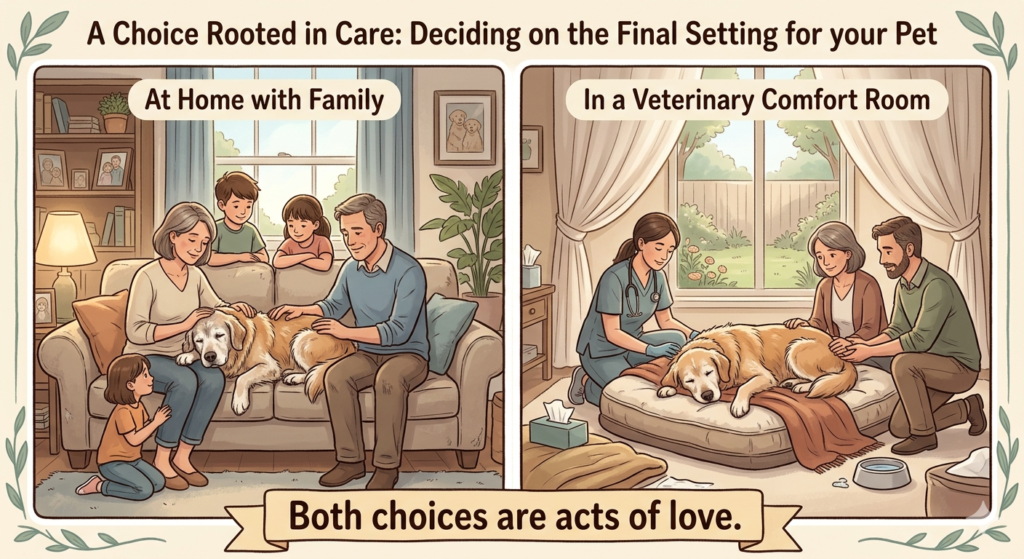
Both options are valid, and the right choice depends on your pet, your family, and your living situation. Some Sacramento owners search “at home pet euthanasia near me” because they want their pet’s last moments to happen on the couch where they always slept. Others prefer the clinic because of cost, the presence of staff support, or simply not wanting that memory in the room they sleep in. There is no wrong answer.
Aftercare Options: What Happens Next
Aftercare is where many families freeze, simply because no one prepared them for the question. Here is the plain version.
Pet Cremation Sacramento Options
There are three main paths in the Sacramento area:
- Communal cremation — Multiple pets are cremated together; ashes are not returned. Often the most affordable option.
- Private cremation — Your pet is cremated alone, and the ashes are returned to you in an urn.
- Witness cremation — You can be present for the cremation itself; some local providers offer this for families who need closure in that form.
Reputable Sacramento cremation partners we work with provide identification tracking from the moment your pet leaves our care until the ashes return, which gives families certainty that the remains they receive are genuinely their pet’s.
What Does the Vet Do With Your Dog When It Dies?
Another question Sacramento owners search constantly, and one we wish more clinics answered openly. After euthanasia, your pet is wrapped gently and placed in a private holding area until cremation pickup, which typically happens within 24 to 48 hours. If you have chosen burial at home (legal in many parts of California, with some county-specific rules), you can take your pet home immediately. If you have requested clay paw prints, fur clippings, or nose prints as keepsakes, those are made before transport. Nothing happens that you have not been told about and consented to.
Memorial Keepsakes and Paw Prints
Tangible mementos help more than people expect. We routinely offer paw print impressions, fur lockets, and ink nose prints. Many families who initially decline these later regret it, so we now ask twice. There is no embarrassment in saying yes.
A Real Sacramento Story: Bella’s Final Week
Bella was a fourteen-year-old golden retriever who came to us with her family — three adults and a nine-year-old — for what they thought would be a routine senior wellness exam. The HHHHHMM scale put Bella at 28 out of 70. Her hips had failed her months earlier; she was no longer eating; the family had been carrying her outside three times a day.
The conversation that day was hard. We explained the quality-of-life numbers, walked through what euthanasia would look like, and gave them the option to take Bella home for one more weekend. They did. They cooked her steak. The nine-year-old read her favorite book aloud. They came back Monday morning, and Bella passed peacefully in her dad’s arms on a blanket from her own bed.
Six months later, the family adopted a senior rescue from a local shelter, partly because Bella’s experience had made them advocates for older dogs nobody else would take. That is what dignified end-of-life care can do — it does not erase grief, but it leaves families intact enough to love again.
Comparing At-Home vs. In-Clinic Euthanasia
| Factor | At-Home Euthanasia | In-Clinic Euthanasia |
|---|---|---|
| Familiar environment | Yes — pet stays in known surroundings | No — clinical setting, but quiet rooms available |
| Family privacy | High — entire household can participate | Moderate — limited by room size |
| Cost | Generally higher due to travel | More affordable |
| Scheduling | Limited to mobile vet availability | Same-week scheduling typical |
| Stress on pet | Minimal | Brief travel stress |
| Aftercare logistics | Body transport must be arranged | Handled directly by clinic |
| Best for | Pets who panic in cars, large dogs, multi-pet households | Cost-conscious families, pets comfortable at the vet |
Grief Therapy for Pet Loss in Sacramento CA: You Are Not Overreacting
The phrase we hear most often in the days after a euthanasia is some version of “I did not expect to feel this bad.” Pet loss grief is real grief. It is recognized in clinical literature as a form of disenfranchised grief — meaning society does not always validate it the way it does the loss of a human family member, even though the bond is often just as deep.
Why Pet Loss Hits So Hard
Pets are woven into the texture of daily life in ways that other relationships often are not. They are there when you wake up, when you come home, when you cry, when you eat dinner alone. The absence shows up dozens of times a day. There is no rule that says you should be over it in a week.
Local Grief Counseling Resources
Sacramento has more options for grief therapy for pet loss than most owners realize:
- The Association for Pet Loss and Bereavement maintains a directory of certified counselors and runs free chat-based support groups several nights a week.
- Many licensed Sacramento therapists now list pet loss as a specialty; searching for “grief counselor for pet loss Sacramento CA” through Psychology Today’s directory will return local clinicians who take this work seriously.
- The ASPCA Pet Loss Hotline offers free phone support staffed by trained grief counselors.
- UC Davis School of Veterinary Medicine runs the Pet Loss Support Hotline, which is staffed by veterinary students and free for California residents.
Online Pet Loss Support Communities
For owners who prefer to grieve privately, moderated online communities such as the Rainbow Bridge forums and Lap of Love’s online support groups provide a place to share without judgment. Many find that simply reading other owners’ stories helps normalize the wave of feelings that follow euthanasia.
Helping Children and Other Pets Grieve
Children deserve the truth, told gently and at their developmental level. Avoid phrases like “put to sleep” with very young children, who may begin to fear bedtime; “her body stopped working and she died” is clearer and ultimately less frightening. Encourage them to participate in memorial rituals — drawings, letters, planting a small garden marker.
Other pets in the household also grieve. Surviving dogs and cats may search the house, sleep more, eat less, or vocalize at night. Most return to baseline within two to four weeks. If a pet’s grief begins affecting their physical health, our behavioral medicine team can help with both medical evaluation and behavior support.
When You Are Ready, We Are Here
You do not have to make any of these decisions alone. If you would like to talk through where your pet is on the quality-of-life scale, or simply want to understand what humane options would look like before you need them, our team is glad to have that conversation with you. You can reach Del Paso Veterinary Clinic at (916) 925-2107 or visit us at 924 Del Paso Blvd, Sacramento, CA 95815.
For families currently navigating senior care concerns, our pet wellness exam guide covers the proactive monitoring that often catches problems early enough to add quality months — sometimes years — to a pet’s life.
Frequently Asked Questions About End of Life Care for Pets
-
How long does it take to put a dog to sleep?
The complete appointment generally lasts 30 to 45 minutes from arrival to departure, though the medical process itself is much shorter. After a heavy sedative is given, your dog drifts into a deep, peaceful sleep over about 5 to 10 minutes. The final injection that stops the heart works within roughly 30 seconds to two minutes. Most families describe the actual passing as so quiet and gentle that it takes a moment to register what has happened.
-
What chemical is used to euthanize dogs?
The drug used is pentobarbital, a barbiturate that has been the veterinary standard for humane euthanasia for decades. At the dose given, it stops brain activity within seconds, which means the animal is unconscious before any other body function changes. There is no pain, no fear, and no awareness once the medication takes effect. Many veterinarians also pre-medicate with a sedative to ensure the pet is fully relaxed beforehand.
-
What does the vet do with your dog when it dies?
After euthanasia, your dog is wrapped gently and placed in a quiet, private holding area until cremation pickup, which typically happens within 24 to 48 hours. If you have requested keepsakes such as paw prints or fur clippings, those are made beforehand. If you have chosen home burial, you can take your dog home directly. Nothing occurs without your prior knowledge and consent — every step is explained to you.
-
Do dogs know when they are dying?
Dogs do not conceptualize death the way humans do, but they absolutely sense changes in their own bodies. Pain, weakness, confusion, and reduced energy register clearly. Some dogs respond by withdrawing and seeking solitude; others become unusually clingy and want constant contact. They are not afraid of dying — they are responding to physical discomfort. Recognizing this distinction often helps families feel less guilt about timing their decision.
-
What do they do with dogs after they are put down?
Aftercare follows whatever option you chose. Most Sacramento families select either communal cremation, where ashes are not returned, or private cremation, where your dog is cremated individually and the ashes are returned to you in an urn. A small number choose home burial where local rules permit. Reputable cremation services use ID tracking throughout the process so the ashes you receive are verifiably your dog’s, providing certainty during a difficult time.
-
Where can I find grief therapy for pet loss in Sacramento CA?
Several strong local resources exist. The UC Davis Pet Loss Support Hotline offers free phone counseling staffed by trained volunteers. The Association for Pet Loss and Bereavement runs free online chat groups multiple times per week. Many licensed Sacramento therapists now list pet bereavement as a specialty — Psychology Today’s directory is a good starting point for finding a clinician who treats pet grief with the seriousness it deserves.
-
Is at home pet euthanasia near me available in Sacramento?
Yes. Mobile veterinary services that offer in-home euthanasia operate throughout the Sacramento area, including coverage of Del Paso Heights, Natomas, Arden-Arcade, and West Sacramento. The benefit is that your pet stays in familiar surroundings; the trade-off is a higher cost and dependence on the mobile vet’s availability. For cat owners specifically searching “cat euthanasia near me,” in-home services often work especially well since many cats find car travel acutely stressful.
-
What pet cremation Sacramento options are available?
Sacramento families generally choose between three options: communal cremation (most affordable, no ashes returned), private cremation (your pet is cremated alone with ashes returned), and witness cremation (you can be present). Most veterinary clinics partner with established local cremation providers who offer ID tracking from pickup through return. Memorial keepsakes such as clay paw prints, ink nose prints, and fur lockets can usually be added regardless of which cremation type you select.
Saying goodbye is the last and hardest gift we give the animals who loved us best — and doing it with knowledge, support, and dignity is what turns an ending into a tribute.