
If you searched spaying for dogs because your appointment is already booked, this guide is built for exactly that moment. Del Paso Veterinary Clinic walks Sacramento pet owners through the entire recovery window after a spay or neuter, from the groggy first evening to the day the incision is fully healed, so you know what is normal and what needs a call to the vet.
Recovery questions tend to peak the day after surgery, when the anesthesia has worn off and the reality of managing a cone-wearing dog for two weeks sets in. This guide covers the day-by-day timeline, activity restrictions, incision care, and the specific warning signs that separate a normal recovery from one that needs same-day attention.
Spay vs. Neuter: Why Recovery Differs
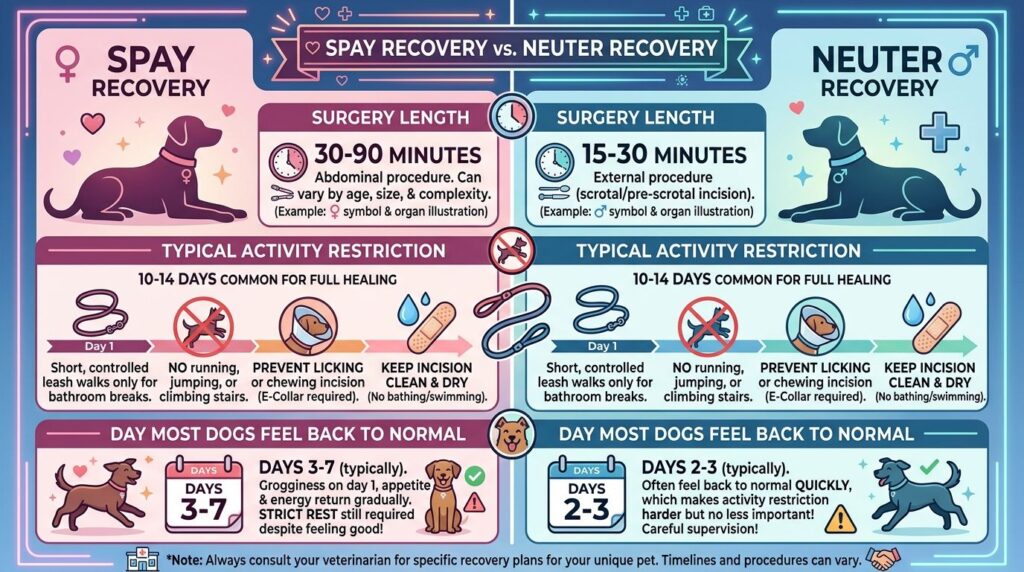
Not every recovery looks the same, and the difference comes down to what the surgery actually involves. Dog spay surgery typically takes 30 to 60 minutes under anesthesia because it requires an abdominal incision to remove the ovaries and uterus. Neuter surgery is generally shorter, often 15 to 30 minutes, since it does not involve entering the abdominal cavity. That difference in surgical depth is exactly why spay recovery tends to take longer and demands closer monitoring than neuter recovery, even though both procedures follow the same general 10 to 14 day restricted-activity window.
Dogs recovering from a neuter often feel close to normal within two to three days. Dogs recovering from a spay usually need the full two weeks before they are truly back to themselves, since the internal healing lags well behind how they feel on the outside. This gap between “acting fine” and “actually healed” is where most recovery mistakes happen.
The First 14 Days: A Day-by-Day Guide
Day 0 to Day 1: The Grogginess Window
Your dog will likely come home sleepy, unsteady, and possibly a little vocal or shivery as the anesthesia wears off. This is normal and typically resolves within 12 to 24 hours. Offer a small amount of their regular food that evening, and expect them to want to sleep more than usual. Set up a quiet, warm, low-traffic space before you even leave for surgery, so you are not scrambling once you get home.
Day 2 to Day 3: Acting Better, Not Actually Better
This stretch is where most owners get caught off guard. Your dog may seem noticeably improved, sometimes wanting to jump on furniture or play with a housemate pet, but the internal healing is nowhere close to finished. Activity restriction matters just as much on day three as it did on day one, particularly after a spay.
Day 4 to Day 7: Steady Healing, Continued Restriction
Mild redness and slight swelling at the incision in these first few days is expected. What is not expected is redness that is increasing rather than fading, or any warmth, discharge, or odor at the site. Keep checking the incision twice daily and keep the cone on at all times, including overnight.
Day 8 to Day 14: The Home Stretch
By the second week, most dogs feel essentially normal, which is precisely when activity slip-ups happen most. The incision may look mostly healed on the surface while internal tissue is still knitting together underneath. Continue restricted activity through the full 14 days, or until your veterinarian clears your dog at a follow-up visit, whichever comes first.
Pain Management: What to Expect from Medication
Most dogs go home with a short course of pain medication, typically a veterinary NSAID, to keep them comfortable while the incision heals. According to VCA Animal Hospitals, proper pain relief after surgery is not just about comfort, it actually speeds healing by reducing stress on the body and encouraging a calmer, more restful recovery. Give every dose exactly as prescribed, even if your dog seems comfortable, rather than skipping doses once symptoms improve.
Never give human pain medication such as ibuprofen, acetaminophen, or aspirin to a dog. These are toxic to dogs even in small amounts and are one of the most common preventable poisoning calls veterinarians receive. If your dog seems painful despite the prescribed medication, or shows side effects like vomiting, loss of appetite, or unusual lethargy, call your veterinarian rather than adjusting the dose yourself.
Feeding and Hydration During Recovery
Offer a small amount of your dog’s regular food the evening of surgery rather than a full meal, since nausea from anesthesia is common in the first several hours. Most dogs are back to a normal appetite and feeding schedule by the following day. Avoid introducing new treats, table scraps, or a different food during the recovery window, since digestive upset on top of surgical recovery makes it harder to tell what is causing what.
If your dog refuses food entirely for more than 48 hours, or shows repeated vomiting rather than a single episode tied to the anesthesia wearing off, that crosses from expected to concerning and warrants a call to your veterinarian.
Cone and Activity Restriction: The Two Non-Negotiables
An Elizabethan collar, or cone, prevents licking and chewing at the incision, which is one of the most common causes of post-surgical complications and infections. The cone stays on for the entire recovery period, not just when you are able to supervise directly. Dogs adjust faster than most owners expect, usually within a day.
Activity restriction means no running, jumping, off-leash time, stairs when avoidable, or rough play with other pets for the full 10 to 14 days. A crate, exercise pen, or a small room blocked off with a baby gate works well for most dogs. Leash walks for bathroom breaks are generally fine, but they should be short and calm rather than a normal walk length. The American Veterinary Medical Association notes that clear written discharge instructions, not just verbal ones, are an important part of preventing post-operative complications, so keep any paperwork from your visit handy during the recovery window.
Incision Care Checklist
- Check the incision twice daily for the full recovery period.
- Look for a clean, dry line with minimal swelling, which is the expected appearance after the first couple of days.
- Keep the incision dry entirely, avoiding baths, swimming, or heavy rain exposure until fully healed.
- Do not apply any ointment, powder, or home remedy to the incision unless specifically instructed.
- Note any small green tattoo near the incision, which some clinics use to mark sterilization; it is not a second wound and does not need separate care.
- Take a quick photo each day if you are unsure whether something has changed, since side-by-side comparison is often the easiest way to catch a subtle shift.
Spay vs. Neuter Recovery: Quick Comparison
| Factor | Spay (Female) | Neuter (Male) |
|---|---|---|
| Surgery type | Abdominal incision | No abdominal entry |
| Typical surgery length | 30 to 60 minutes | 15 to 30 minutes |
| Activity restriction | 10 to 14 days | 10 to 14 days |
| Days until dog feels “back to normal” | Often the full 2 weeks | Often 2 to 3 days |
| Incision monitoring | Twice daily, full 2 weeks | Twice daily, full 2 weeks |
Warning Signs That Need a Same-Day Vet Visit
Most recoveries are uneventful, but knowing the difference between a normal healing sign and a real complication matters. Contact your veterinarian right away, or seek same-day urgent care, if you notice any of the following:
- An incision that is open, gaping, or has any tissue visible through it.
- Discharge that looks like pus, or any noticeable odor from the incision.
- Redness or swelling that is increasing after day three rather than fading.
- Active bleeding beyond a small amount immediately after surgery.
- Ongoing lethargy, repeated vomiting, or diarrhea beyond the first evening.
- Refusal to eat for more than 48 hours after surgery.
- Difficulty urinating or visible straining.
According to ASPCA post-surgical guidance, strenuous activity during recovery is one of the most common causes of incisions reopening, which is exactly why the restriction window matters more than how the dog seems to be feeling.
Finding a Spay and Neuter Clinic in Sacramento
Sacramento owners searching spay and neuter near me or a spay and neuter clinic near me are often comparing options after already deciding to move forward with the procedure. At Del Paso Veterinary Clinic’s spay and neuter clinic, every procedure includes anesthesia monitoring, pain management, and clear post-operative instructions so you know exactly what to expect once you get home. If you are still deciding whether and when to schedule the procedure, our spay and neuter guide covers timing, preparation, and the benefits of spaying and neutering in more detail.
Patient Story: Daisy’s Spay Recovery
Daisy, a two-year-old mixed-breed dog, came to Del Paso Veterinary Clinic for a routine spay. Her owner followed the standard 14-day activity restriction closely for the first week, and by day eight, Daisy was acting completely normal, bouncing around the living room and clearly ready to play. Her owner noticed mild redness at the incision that seemed slightly more pronounced than it had been on day five and called the clinic the same afternoon rather than waiting to see if it resolved on its own.
Dr. Khabra examined Daisy that day and found the redness was a mild, early-stage irritation rather than a true infection, likely from Daisy managing to rub the area against a piece of furniture despite the cone. A brief adjustment to her recovery setup and a few more days of closer supervision resolved it without further treatment. Daisy’s owner later noted that calling early, rather than waiting to see if it got worse, was the reason it stayed minor.
Related Care Around Surgery Day
Recovery goes more smoothly when the surgery itself starts with a solid pre-surgical workup. Our pet surgery guide covers what to expect from consultation through discharge for spay, neuter, and other surgical procedures performed at our Del Paso Blvd location.
A calm two weeks now means a fully healed pet later, and that trade is always worth making.
Frequently Asked Questions
-
How long is recovery after spaying a dog?
Most dogs need the full 10 to 14 days of restricted activity to heal after a spay, even though many start acting normal well before that window closes. The abdominal incision needs that full time to heal internally, regardless of how energetic your dog seems on the surface. Your veterinarian will confirm healing at a follow-up visit before clearing normal activity.
-
Is neuter recovery faster than spay recovery for dogs?
Yes. Neuter surgery does not involve entering the abdominal cavity, so most male dogs feel close to normal within two to three days, compared to the full two weeks that spay recovery typically requires. Both procedures still call for the same general 10 to 14 day activity restriction window to protect the incision from strain or reopening.
-
What if my dog keeps trying to remove the cone?
The cone needs to stay on for the entire recovery period, including overnight, since licking and chewing at the incision is one of the most common causes of complications. Most dogs adjust within a day or two, though it can be frustrating at first. If the cone genuinely does not fit or is causing distress, call your veterinarian rather than removing it entirely.
-
When should I worry about redness at the incision site?
Mild redness in the first two to three days after surgery is a normal part of healing. Redness that increases after day three, or that comes with warmth, swelling, discharge, or an odor, is not normal and warrants a same-day call to your veterinarian. Checking the incision twice daily makes it much easier to catch these changes early.
-
Can my dog go up and down stairs during recovery?
Stairs should be avoided when possible during the 10 to 14 day recovery window, since the up-and-down motion puts strain on the incision similar to jumping. If stairs are unavoidable in your home, carry smaller dogs or use a leash to keep larger dogs moving slowly and under control rather than bounding up or down on their own.
-
What counts as an emergency after spay or neuter surgery?
An open or gaping incision, active bleeding, pus-like discharge, ongoing vomiting or diarrhea, refusal to eat for more than 48 hours, or difficulty urinating all warrant same-day veterinary attention rather than waiting to see if things improve. When in doubt about whether something is a normal part of healing, a quick call to your veterinarian is always the safer choice.