Spay and Neuter in Sacramento: What Every Pet Owner Needs to Know
Every spring, our front desk fields the same conversation a few dozen times: a new puppy or kitten owner wants to do the right thing, has heard they should “fix” their pet, but isn’t sure what that actually means, when to do it, or what the recovery looks like. If you’re somewhere in that same place, this guide is for you. At Del Paso Veterinary Clinic, we’ve been performing spay and neuter procedures for Sacramento pet owners for decades, and what follows is the same straightforward information we share in our exam rooms — without the marketing fluff.
Spay and neuter Sacramento services have become safer and more accessible than ever, but the choices you make about when and where to have the procedure done still matter for your pet’s lifelong health. This guide walks through every part of the experience: what the surgery actually involves, the medical benefits backed by current veterinary research, how to prepare your dog or cat at home, what happens inside the surgical suite, and how to manage recovery without losing your mind during those first 14 days.
Two terms, two procedures. Spaying is performed on female dogs and cats and is technically called an ovariohysterectomy — the surgical removal of both ovaries and the uterus. Neutering (sometimes called castration or “fixing”) refers to the removal of a male pet’s testicles, technically known as orchiectomy.
Both procedures are performed under general anesthesia in a sterile surgical suite. A small incision is made — in the lower abdomen for spays, near the scrotum for neuters — and the reproductive organs are carefully removed. Modern surgical techniques, refined anesthetic protocols, and post-operative pain management have made these among the most routine and well-understood operations in veterinary medicine.
That doesn’t mean they’re trivial. Any abdominal procedure involves anesthesia, recovery, and the same care standards that apply to other operations. That’s why where the surgery is done — and how rigorously the patient is monitored — has a real impact on outcomes.
Health Benefits of Spaying and Neutering Your Pet
The medical case for sterilization is strong, and it goes well beyond preventing unplanned litters.
Cancer and Disease Prevention
Spaying a female dog before her first heat cycle can reduce the lifetime risk of mammary tumors — the canine version of breast cancer — to less than half a percent. Wait until after several heat cycles and that risk climbs significantly. The procedure also eliminates the possibility of pyometra, a life-threatening uterine infection that disproportionately affects unspayed older females and often requires emergency surgery to treat.
For male dogs, neutering removes the risk of testicular cancer entirely and lowers rates of prostate disease and certain perianal tumors. Cats see similar benefits: spayed females are protected from uterine infections and mammary cancer, while neutered males have a much lower risk of injury from roaming and fighting. The ASPCA’s guide to spaying and neutering covers these protective effects in more depth.
Behavioral Improvements
Hormone-driven behaviors tend to soften after surgery. Male dogs and cats are typically less inclined to roam, urine-mark territory, or display same-sex aggression. Female pets no longer go into heat, which means no more bleeding cycles in dogs or yowling vocalizations in cats. None of this changes your pet’s core personality — they’ll still be the same goofy, affectionate companion you brought home — but the more frustrating hormonal behaviors usually fade.
Population and Community Impact
Sacramento County shelters intake thousands of unwanted dogs and cats every year. Pet sterilization is the single most effective intervention any individual owner can take to ease that burden. The American Veterinary Medical Association maintains extensive guidance on responsible pet ownership and population control that aligns with what most ethical vets recommend.
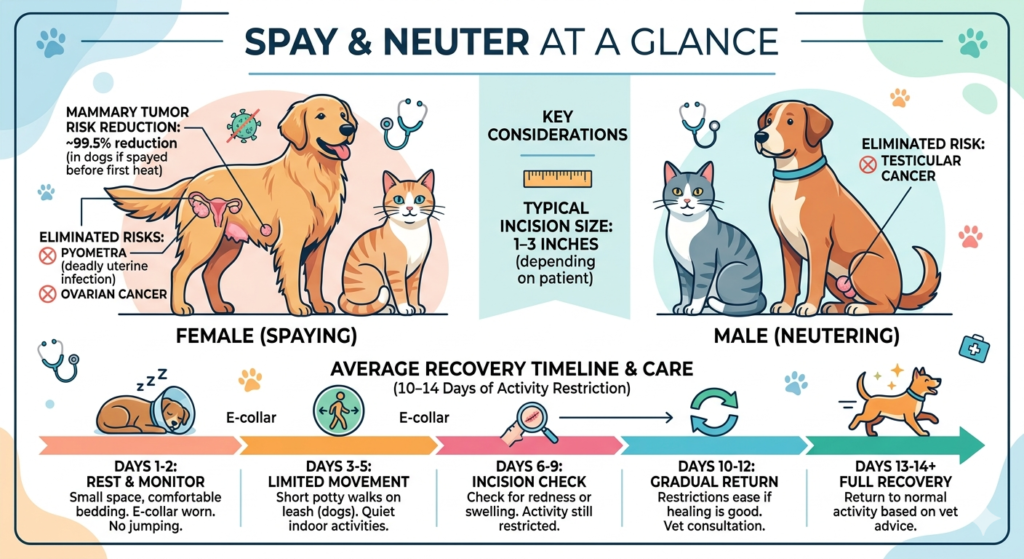
Spay & Neuter at a Glance
Mammary tumor risk reduction (dogs spayed before first heat): ~99.5%
Eliminated risks: Testicular cancer, pyometra, ovarian cancer
Average recovery time: 10–14 days of activity restriction
Typical incision size: 1–3 inches depending on patient
When to Spay or Neuter Your Pet
There’s no universal answer, and anyone who tells you there is hasn’t read the research. The right age depends on species, breed, sex, size, and lifestyle.
Recommendations for Dogs by Size
For most small and medium breed dogs, the traditional six-month window remains a reasonable starting point. For large and giant breeds — Labradors, Golden Retrievers, German Shepherds, Great Danes — newer evidence suggests waiting longer can reduce the risk of orthopedic conditions like cranial cruciate ligament rupture and hip dysplasia. Many veterinarians now recommend large-breed males be neutered between 12 and 24 months, and large-breed females after their first heat cycle, depending on the individual case.
Cats are simpler. Most veterinarians, including our team, recommend spaying or neutering kittens around 4 to 6 months of age — before sexual maturity, which can hit as early as 5 months in some females. Early surgery prevents unwanted litters and reduces the chance of behaviors like spraying becoming permanent.
Adult and Senior Pets
We also routinely spay and neuter adult and older pets. Age alone is not a contraindication. With a thorough pre-anesthetic exam and bloodwork through our in-house diagnostics and lab, we can safely perform the procedure on dogs and cats well into their senior years.
Pre-Surgery Pet Care — Preparing at Home
Good preparation makes the surgery day smoother for everyone — pet, owner, and surgical team.
The Pre-Anesthetic Examination
Every patient receives a physical exam and, in most cases, pre-anesthetic bloodwork before surgery. This isn’t a formality. Bloodwork screens for hidden conditions — kidney or liver issues, low platelets, anemia — that can change how a pet handles anesthesia. Pets up to date on annual pet checkups generally have a smoother pre-op process.
Fasting and Medication Guidelines
Most patients are asked to withhold food after midnight the night before surgery, with water typically allowed up to morning. If your pet takes daily medications, ask the clinic ahead of time whether to give them as scheduled. Don’t assume one way or the other.
What to Bring on Surgery Day
A leash or carrier, a list of any medications and recent vaccines, your contact information, and any specific concerns you want the doctor to know. If your pet hasn’t been recently vaccinated, current puppy vaccinations (or kitten vaccines) may need to be addressed before scheduling.
Inside the Surgical Suite — What Happens During the Procedure
When you drop your pet off, here’s the sequence of events most owners never see:
Admission and final exam. The team rechecks weight, temperature, heart rate, and overall condition.
IV catheter placement. This provides fluid support during anesthesia and a route for emergency medications if needed.
Pre-medication. Sedatives and pain medications are given to relax the patient.
Induction. General anesthesia is administered, the patient is intubated, and inhalant anesthesia maintains a stable plane.
Continuous monitoring. A dedicated technician monitors pulse oximetry, ECG, blood pressure, body temperature, and end-tidal CO₂ throughout.
Surgery. The procedure itself usually takes 20 to 60 minutes depending on size, sex, and individual factors.
Recovery. The patient wakes in a warm, quiet space under direct observation.
This is the same monitoring standard applied to every pet surgery near me procedure performed in our suite — not just spays and neuters.
After Surgery Pet Care — Recovery at Home
Most pets are discharged the same day, alert but groggy. Here’s what the next two weeks typically look like.
The First 24 Hours
Expect drowsiness, reduced appetite, and a quieter-than-usual pet. Offer a small meal in the evening, keep them confined to a calm area, and check the incision once or twice for swelling, bleeding, or discharge. Most clinics, ours included, send patients home with an Elizabethan collar — keep it on. A licked incision can become infected fast.
Days 2 Through 14
Activity restriction is the part owners struggle with most. No running, jumping, rough play, swimming, or off-leash time for 10 to 14 days. Short, leashed bathroom walks only. Crate rest, an exercise pen, or a small room works well for energetic pets.
Warning Signs That Need Urgent Attention
Contact a veterinarian right away if you see:
Active bleeding from the incision
Pus, foul odor, or significant swelling around the surgical site
Opening or gaping of the incision
Persistent vomiting or refusal to eat past 24 hours
Difficulty breathing, pale gums, or extreme lethargy
If you can’t reach your regular vet, our team handles post-operative concerns through urgent same-day veterinary care when we’re open. For overnight emergencies, the nearest 24-hour emergency hospital is the right call — we keep referrals on hand for our spay and neuter patients.
Bella’s Recovery — A Patient Story
Bella, a two-year-old Labrador mix, came in for her spay last fall. Her owner had delayed the procedure twice — first because of work schedules, then because she was nervous about anesthesia. Pre-anesthetic bloodwork came back clean. Bella was admitted, surgery took 35 minutes, and she went home that afternoon.
The recovery wasn’t perfect. On day three Bella jumped off the couch chasing a squirrel through the window, popping a single suture. Her owner called immediately. We had her back in the same morning, replaced the suture, sent her home with a slightly stricter activity plan, and she healed without further issue. Two weeks later her incision was a thin pink line, and at her one-year follow-up there was no scar to find.
The takeaway: complications are uncommon, almost always manageable when caught early, and rarely change the long-term outcome.
How Spay and Neuter Care Varies by Clinic Type
Not all providers operate the same way. Here’s a practical comparison of the three options Sacramento pet owners encounter most often:
Feature
Low-Volume Clinic
Full-Service Animal Hospital
Mobile / High-Volume Clinic
Pre-anesthetic exam
Often minimal
Comprehensive, every patient
Brief, standardized
Pre-op bloodwork
Rarely included
Recommended or standard
Optional add-on
Anesthesia monitoring
Variable
Continuous, multi-parameter
Limited, single-parameter
Dedicated monitoring tech
No
Yes
No
Same-day urgent follow-up
No
Yes
No
Post-op recheck included
Sometimes
Yes
Sometimes
Best fit for
Healthy young pets, simpler cases
Any pet, any age, any breed
Healthy young pets, single-day events
A full-service hospital is more comprehensive on the surgical day but typically catches anesthetic risks earlier and provides continuity of care if something doesn’t look right two days later.
Microchipping During the Same Visit
Many owners take advantage of the surgery day to add microchipping — a quick procedure done while the pet is already under anesthesia, so they don’t feel the implant. It’s one of the few decisions that, statistically, has a measurable impact on the chance of recovering a lost pet.
Frequently Asked Questions
At what age should I spay or neuter my pet in Sacramento?
For most cats and small-breed dogs, four to six months is the standard recommendation. Large and giant-breed dogs often benefit from waiting until 12 to 24 months — research links early sterilization in those breeds to a higher rate of joint and ligament issues. The right age depends on species, breed, sex, and lifestyle, so the safest answer is to discuss your individual pet with a veterinarian during a pet wellness exam.
How long is the recovery period after spay or neuter surgery?
Plan on 10 to 14 days of strict activity restriction. Most pets are alert within 24 hours, eating normally within 48, and back to themselves within a week — but the incision continues to heal internally for up to two weeks. No running, jumping, swimming, or rough play during that window. Keeping the cone on and following discharge instructions is the single most important thing you can do to prevent complications and ensure full healing.
Will spaying or neutering change my pet’s personality?
No. Core personality traits — playfulness, affection, trainability, intelligence — are not affected by sterilization surgery. What does change are hormone-driven behaviors: roaming, urine marking, fighting between same-sex animals, and the bleeding and yowling associated with heat cycles. Pets typically become calmer in those specific situations but remain the same companion you’ve always known. Most owners report no noticeable change in their pet’s character or daily routine.
Can older pets still be safely spayed or neutered?
Yes. Age alone isn’t a reason to skip the procedure, especially for unspayed females, who face rising risks of pyometra and mammary tumors as they get older. Pre-anesthetic bloodwork, a thorough physical exam, and adjusted anesthetic protocols make adult and senior surgeries routinely safe. Many of our patients are spayed or neutered well into their senior years with excellent outcomes. The decision should be made case by case with a veterinarian who knows your pet’s full history.
Are there real risks involved with the procedure?
All surgery carries some risk, but spay and neuter are among the most common and well-understood procedures in veterinary medicine. Anesthetic complications are rare with modern monitoring protocols and pre-anesthetic screening. Post-operative complications — usually minor and incision-related — occur in roughly 2 to 5 percent of cases and are almost always manageable when caught early. That’s why choosing a clinic offering spay and neuter surgery with continuous monitoring and same-day follow-up matters.
What should I do if my pet seems unwell after surgery?
Some grogginess and reduced appetite for the first 24 hours is normal. Contact a veterinarian if you notice active bleeding, foul-smelling discharge, persistent vomiting, refusal to eat past day two, lethargy that worsens instead of improves, or any opening of the incision. Our urgent pet care guide for Sacramento owners walks through the warning signs in detail. When in doubt, call. Phone triage is fast and free.
Spay and neuter surgery is one of the most consequential health decisions you’ll make for your pet — and one of the most rewarding when it goes well.