
Most cat owners start by asking about FeLV test cost, but the more useful questions are when to test, what a positive result really means and what happens next. Feline leukemia virus (FeLV) and feline immunodeficiency virus (FIV) are the two retroviruses every cat should be screened for at least once. This guide from Del Paso Veterinary Clinic, a cat vet near me option for North Sacramento families since 1940, covers how the test works, how to read the results and how to care for a cat that tests positive.
FeLV vs FIV: Two Different Viruses
FeLV and FIV are usually tested together on one small blood sample, so people tend to lump them together. They behave very differently, though.
| FeLV (Feline Leukemia Virus) | FIV (Feline Immunodeficiency Virus) | |
|---|---|---|
| How common | About 2 to 3% of cats in the US and Canada | About 2.5 to 5% of healthy cats in North America |
| Main spread | Close contact: grooming, shared bowls and litter boxes, bites, mother to kittens | Deep bite wounds, mostly during fights |
| Highest-risk cats | Kittens, cats living with infected cats, outdoor cats | Unneutered males with outdoor access |
| What the screening test detects | Virus protein (antigen) in the blood | Antibodies the cat makes against the virus |
| Vaccine | Yes, considered core for kittens | Not available in the US |
| Typical outlook | Median survival about 2.5 years after diagnosis, often longer with regressive infection | Many cats live normal lifespans with good care |
Figures come from the Cornell Feline Health Center’s pages on feline leukemia virus and feline immunodeficiency virus.
The short version: FeLV spreads more easily and is more serious. FIV spreads mainly through fighting, and a cat with FIV can often live a long, comfortable life.
Which Cats Should Be Tested, and When
The American Association of Feline Practitioners recommends that every cat’s FeLV and FIV status be known. Its feline retrovirus management guidelines are the standard most vets follow. In practice, testing makes sense at these points:
- When you adopt or take in a new cat, especially strays, barn cats or cats from unknown backgrounds.
- Before introducing a new cat to cats already in your home.
- Before the first FeLV vaccine, since vaccinating an infected cat does nothing to help it.
- When a cat is sick, particularly with weight loss, fever, mouth inflammation or infections that keep coming back.
- After a possible exposure, such as a fight with an unknown cat or an abscess from a bite.
- On a regular schedule for cats at ongoing risk, such as indoor-outdoor cats.
Testing Before Vaccines
FeLV vaccination is recommended for kittens and for adult cats that go outdoors or live with cats of unknown status. Testing first confirms the vaccine is worth giving. Our walk-in clinic for cat vaccinations near me can run the FeLV/FIV test on site so a negative cat can be vaccinated during the same visit.
Kittens and the FIV Maternal Antibody Problem
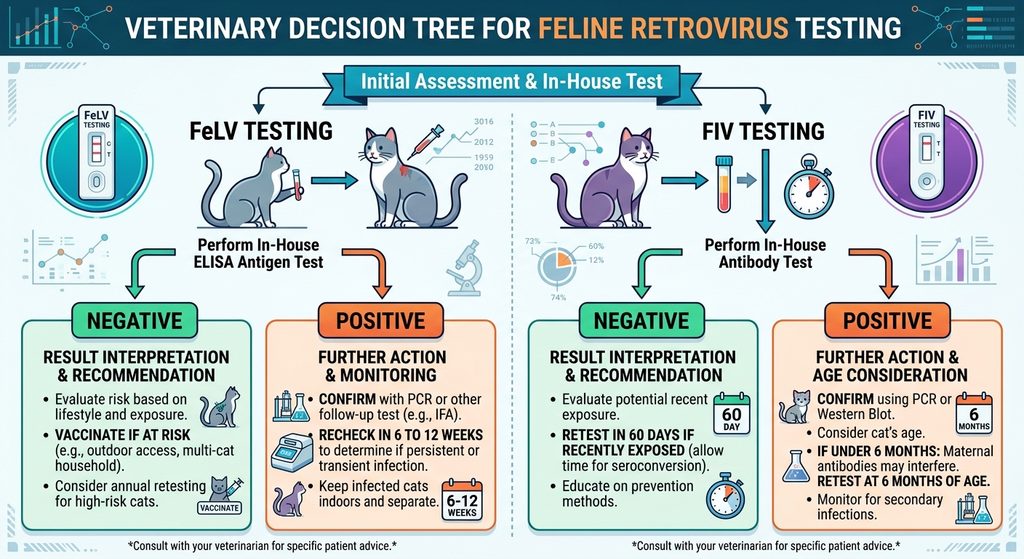
Kittens under six months old can test FIV positive simply because they absorbed antibodies from their mother’s milk. That does not mean they are infected. Cornell recommends retesting these kittens every 60 days until they reach six months; a positive result after that age almost always reflects true infection. FeLV tests are not affected by maternal antibodies, so a kitten’s FeLV result can be read at face value. If you are planning a kitten’s first-year shots, our guide to kitten vaccinations near me lays out where testing fits in the schedule.
The Window After Exposure
Neither test turns positive the moment a cat is infected. FeLV usually needs a few weeks to show up in the blood, and FIV antibodies can take two months or more. If your cat was exposed recently, a negative result is a good sign but not the final word. Plan a retest: a few weeks later for FeLV, and at least 60 days after the exposure for FIV.
How the Test Works at Del Paso Veterinary Clinic
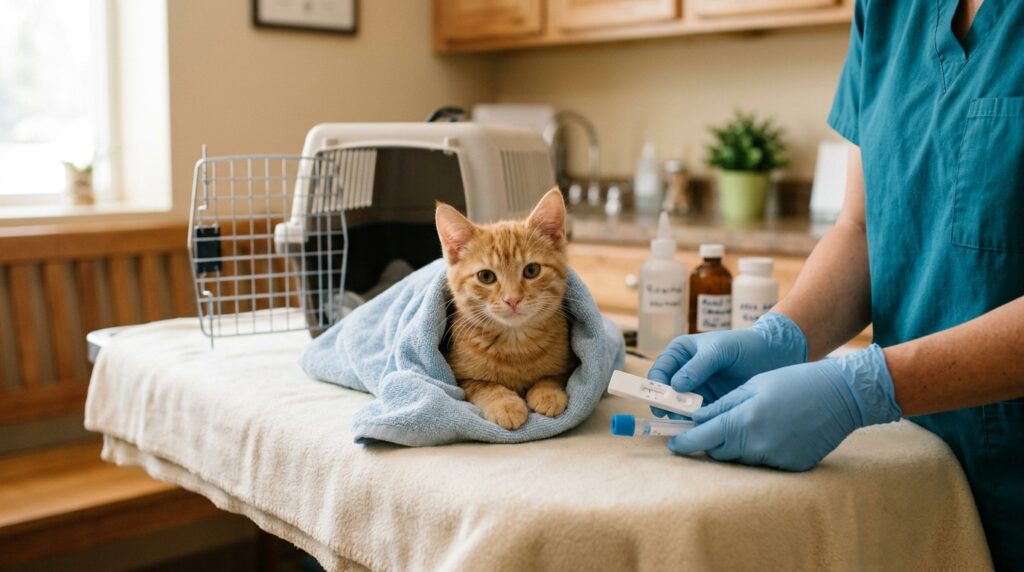
The screening test uses only a few drops of blood. It runs in our in-house diagnostics lab, so results are ready the same day, usually during your visit. For a nervous cat, that means one trip and one needle instead of two.
Screening Tests vs Confirmatory Tests
A positive screening result is never treated as a final diagnosis. Both screening tests can occasionally give false positives, so positives are confirmed with a second, different method, typically sent to an outside reference laboratory.
| Test | What It Detects | When It Is Used |
|---|---|---|
| In-house combination test (ELISA) | FeLV antigen and FIV antibodies | First screening for all cats |
| PCR | Viral genetic material | Confirming FeLV positives, sorting out unclear FIV results in kittens |
| IFA | FeLV inside white blood cells | Identifying progressive FeLV infection |
| Western blot or IFA for FIV | FIV antibodies by a second method | Confirming an FIV positive |
What Your Cat’s Results Mean
Negative for Both
This is the result most cats get. If there has been no exposure in the past couple of months, your cat can be considered free of both viruses. Keep up with FeLV vaccination if your cat goes outdoors, and retest after any fight or new exposure.
FeLV Positive
FeLV infection can go in different directions. Some cats develop a progressive infection, where the virus keeps replicating and illness is more likely. Others mount a strong immune response and settle into a regressive infection, where the virus is held in check and the outlook is much better. Because a cat can move between these states early on, Cornell recommends rechecking most positives 6 to 12 weeks later, along with PCR testing, before deciding on a long-term plan.
FIV Positive
In an adult cat with a confirmed result, FIV positive means lifelong infection. That sounds grim, but many FIV cats live as long as their uninfected housemates. In kittens under six months, it may simply reflect their mother’s antibodies, so a retest comes first.
Positive for Both
A cat with both infections faces a more guarded outlook, because FIV’s lower immunity combined with FeLV’s effects raises the risk of illness. Close monitoring and quick treatment of any infection matter most for these cats.
FeLV Test Cost: What Shapes the Total
Clinics price FeLV and FIV testing in different ways, so a quote from one place may not compare directly with another. These factors usually shape the total:
- Whether the test is part of a wellness or new-patient exam, or a separate visit.
- Whether you need FeLV alone or the combination FeLV/FIV test. Most cats benefit from both.
- Confirmatory tests if the screening result is positive.
- Retests for kittens with FIV-positive results or cats with recent exposure.
- Vaccines given at the same visit if your cat tests negative.
- Follow-up bloodwork for cats that test positive, to check overall health.
Same-day in-house results also save the cost and stress of a second trip just to hear the outcome. If you have been searching for cheap vets near me for cats because a vet bill is hard to cover in one go, the clinic accepts CareCredit and ScratchPay payment plans. Call (916) 925-2107 for current details on testing.
Next Steps After a Positive Result: Living Well With FeLV or FIV
A positive result changes how you care for your cat, not how much you love them. These steps make the biggest difference.
Keep Your Cat Indoors
Indoor living protects your cat from infections their immune system may struggle with, and protects other cats in the neighborhood.
Plan Around Other Cats in the Home
FeLV spreads through everyday contact, so an FeLV-positive cat ideally lives as the only cat, or apart from FeLV-negative cats. Any FeLV-negative housemates should be vaccinated. FIV is different: casual contact like sharing bowls or grooming does not seem to spread it efficiently, so an FIV-positive cat can often live with other cats that get along and do not fight.
Neuter to Reduce Fighting
Because FIV spreads through bites, neutering lowers the urge to roam and fight. If your cat is still intact, our cat neuter near me service is one of the most effective protective steps you can take.
Book Wellness Exams Every Six Months
Cats with either virus need closer monitoring: twice-yearly exams, weight checks and annual bloodwork and urinalysis. Twice-yearly visits with a cat vet sacramento owners trust help catch secondary infections before they take hold.
Watch the Mouth
Gum inflammation and stomatitis are common in FeLV and FIV cats and can make eating painful. A cat dentist visit can ease that pain and keep mouth infections from spreading.
Act Quickly When Your Cat Seems Unwell
Most illness in retrovirus-positive cats comes from secondary infections. Fever, appetite loss, sneezing, diarrhea or lethargy all deserve a same-week visit rather than a wait-and-see approach.
Case Study: Biscuit’s Two FIV Tests
This example is a composite of typical cases at the clinic. Names and identifying details have been changed.
The patient: Biscuit, a ten-week-old gray kitten found under a porch in Del Paso Heights.
The first test: His new owner brought him in for a first exam and vaccines. The in-house combination test came back FeLV negative but FIV positive. The owner, who already had an older cat at home, was understandably worried.
What we explained: At ten weeks old, the FIV result most likely reflected antibodies passed from his mother, not infection. Biscuit got his FVRCP vaccine, a deworming treatment and a plan to retest.
The follow-up: Retests at intervals brought his FIV result back negative by six months of age. He was neutered, finished his core vaccines including FeLV, and now shares the house peacefully with his older companion.
The takeaway: One positive screening result in a young kitten is a reason to retest and confirm, never a reason to panic.
Choosing a Cat Vet in Sacramento
Cats are not small dogs, and many dislike the car, the carrier and the waiting room. Whether you are searching for a cat veterinarian near me or comparing cat vets near me, look for gentle handling, a quick turnaround on lab work and a team that explains results plainly. Some owners assume they need a dedicated sacramento cat hospital for testing like this, but a well-equipped neighborhood cat clinic with an in-house lab handles screening, confirmation and long-term monitoring. A cat clinic Sacramento owners can reach in a short drive also makes the retests and twice-yearly visits far easier to keep up with.
Dr. D. Khabra brings 18 years of experience and AVMA membership, and the team speaks English, Spanish, Punjabi and Hindi. The clinic serves Del Paso Heights, North Sacramento, Natomas, Robla, Arden-Arcade and West Sacramento from 924 Del Paso Blvd, Sacramento, CA 95815. To set up testing with a cat vet, request a time online or call (916) 925-2107.
Frequently Asked Questions
-
How much does an FeLV test cost?
FeLV test cost depends on how the test is done and what else your cat needs. A combined FeLV/FIV screen is often run alongside a wellness or new-patient exam, and vaccines can be added the same day if the result is negative. Positive results usually need confirmatory testing and a recheck, which adds to the total. For current details on testing at Del Paso Veterinary Clinic, call (916) 925-2107 and ask what your cat’s visit will include.
-
How long do FeLV and FIV test results take?
At Del Paso, the screening test runs in the in-house lab, so results are usually ready during the same visit. That lets the team vaccinate a negative cat right away or begin planning next steps for a positive one without a second trip. If a positive result needs confirmation, the follow-up sample goes to an outside reference laboratory, and those results typically take a few days to come back.
-
Can an indoor cat get FeLV or FIV?
An indoor-only cat that lives alone or with tested, negative cats has a very low risk. Infection usually comes from contact with an infected cat, such as a new cat brought home without testing, a cat that slips outside and gets into a fight, or a kitten infected by its mother before adoption. That is why testing every new cat before introducing it to your household matters, even if all your cats stay indoors.
-
Can an FIV-positive cat live with other cats?
Often, yes. FIV spreads mainly through deep bite wounds, and casual contact such as sharing food bowls, litter boxes or grooming does not appear to spread it efficiently. A stable household of cats that get along and do not fight is usually a workable home for an FIV-positive cat. FeLV is different: it spreads through everyday contact, so FeLV-positive cats are best kept apart from FeLV-negative cats, and any negative housemates should be vaccinated.
-
Does the FeLV vaccine cause a positive test result?
No. The FeLV vaccine does not cause a positive result on standard FeLV tests, which look for the virus itself rather than antibodies. That is why vets can test a cat with an unknown history and then vaccinate on the same day. FIV is different, because its test detects antibodies. An FIV vaccine once sold in North America could make vaccinated cats test positive, so share any known vaccine history with your vet.
-
Where can I find a vet near me for cats in Sacramento?
Del Paso Veterinary Clinic at 924 Del Paso Blvd sees cats and kittens from across Sacramento, including Del Paso Heights, North Sacramento, Natomas and Arden-Arcade. FeLV/FIV testing runs in the in-house lab with same-day results, and the walk-in vaccine clinic serves cats without an appointment. For exams, testing after a possible exposure or follow-up care for a positive result, request a time online or call (916) 925-2107 to speak with the team.
A few drops of blood answer two of the biggest questions about your cat’s future health. Test once, then test again whenever life changes.