
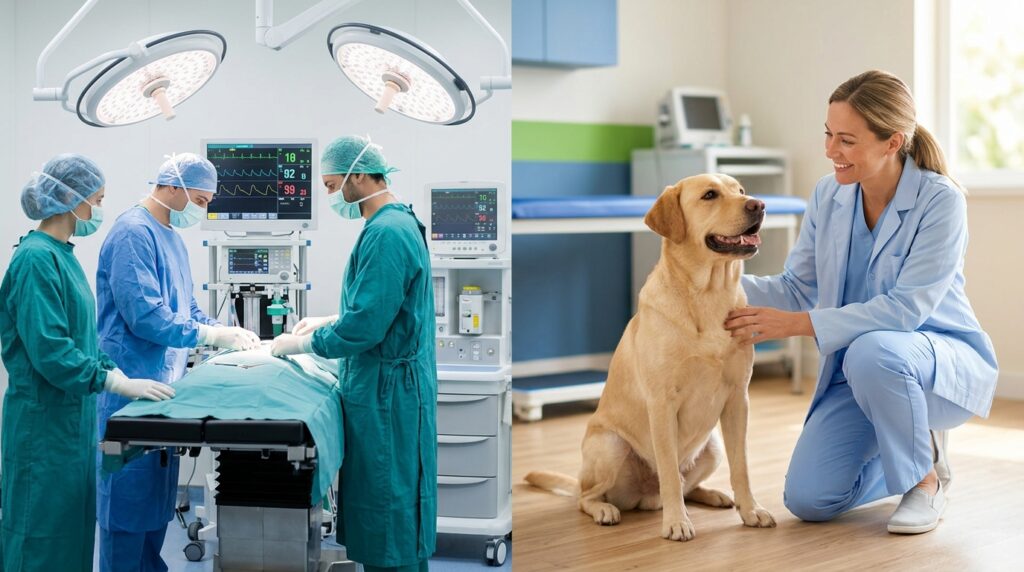
When you search for an animal hospital in Sacramento, you will notice that some practices call themselves hospitals, some call themselves clinics, and a few use both words on the same sign. It is easy to assume the terms are interchangeable marketing labels, and often they are. But underneath the naming, there are real differences in what a facility can actually do for your pet, and understanding those differences helps you pick a practice that matches the care your animal will need. This guide breaks down what separates a full-service hospital from a basic clinic, in plain capability terms, so the label on the door never surprises you at the worst possible moment.
The distinction matters most when something goes wrong. A practice that can run bloodwork on-site, take digital X-rays, and move straight into surgery under proper anesthetic monitoring handles a sick pet very differently from one that has to refer you elsewhere for anything beyond a vaccine and an exam. Choosing well means looking past the words and asking what a facility is equipped to handle. Below, we walk through the capabilities that define the difference and how to judge a Sacramento practice on substance rather than signage in 2026.
What “Animal Hospital” and “Veterinary Clinic” Actually Mean
Neither term is legally protected in a way that guarantees a fixed set of services, which is exactly why the label alone can mislead. In everyday use, a veterinary clinic tends to describe an outpatient practice focused on wellness visits, vaccinations, and minor treatments. An animal hospital near me in Sacramento usually implies a broader facility that can diagnose, treat, operate on, and sometimes hospitalize patients on-site.
That said, plenty of excellent practices call themselves clinics while offering full hospital-level services, and some hospitals keep a narrow scope. The word is a starting point, not a guarantee. What you are really evaluating is capability: what happens when your dog needs an X-ray, when your cat needs surgery, or when a routine exam turns up something that needs deeper investigation. A practice that keeps those next steps under one roof spares you the delay, cost, and stress of being sent across town mid-crisis.
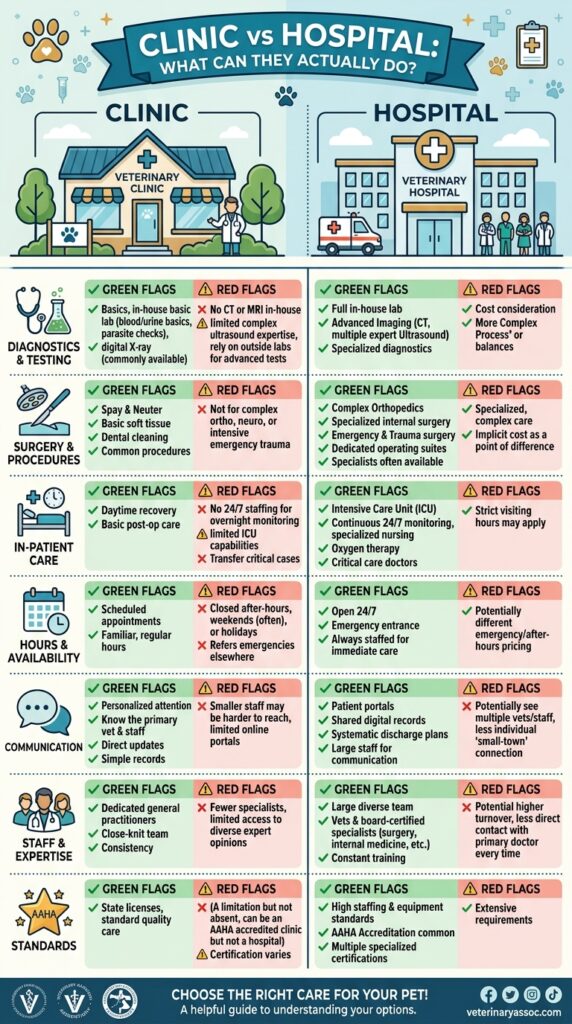
Hospital vs Clinic: A Capability Comparison
The clearest way to cut through the naming is to compare what each type of facility can typically do. Remember that these are tendencies, not rules, and any individual practice may sit anywhere on this spectrum regardless of its name.
| Capability | Basic veterinary clinic | Full-service animal hospital |
|---|---|---|
| Wellness exams and vaccinations | Yes | Yes |
| Parasite prevention and minor treatments | Yes | Yes |
| In-house bloodwork and lab | Sometimes | Yes |
| Digital X-ray and imaging | Rarely | Yes |
| On-site surgical suite | Rarely | Yes |
| Anesthesia with full patient monitoring | Limited | Yes |
| Dentistry under anesthesia | Sometimes | Yes |
| Same-day hospitalization and observation | No | Yes |
| Referrals for advanced specialty care | Yes | Yes |
The Capabilities That Separate a Hospital From a Basic Clinic
Rather than trust the name, look at the equipment and services a practice maintains. These are the capabilities that mark a facility as a true full-service hospital.
An on-site surgical suite. Surgery is the clearest dividing line. A facility with a dedicated surgical suite can handle routine procedures like spay and neuter surgery as well as more involved operations, from mass removals to foreign-body retrieval. The presence of a proper operating space, sterile instrumentation, and a trained surgical team means your pet does not have to be referred out for procedures that a general-practice hospital performs routinely. Facilities that offer comprehensive pet surgery near me treat the surgical suite as core infrastructure, not an occasional add-on.
In-house diagnostics and a lab. When a pet is unwell, the speed of diagnosis often decides the outcome. A hospital with an on-site laboratory can run bloodwork, urinalysis, and other tests during the visit and act on the results the same day, rather than sending samples out and waiting. That capability turns a vague “let’s see how she does” into a concrete plan. Practices that invest in in-house diagnostics can catch kidney changes, infections, and metabolic problems while there is still time to intervene, which is exactly the advantage you want when your animal is clearly suffering and the cause is not obvious.
Anesthesia and patient monitoring. Any procedure beyond the simplest exam may require sedation or general anesthesia, and this is where hospital-level care truly shows. Safe anesthesia is not just about the drugs. It depends on a pre-anesthetic workup, careful patient selection, and continuous monitoring of heart rate, blood pressure, oxygenation, and temperature throughout the procedure. The American Veterinary Medical Association explains that monitoring during anesthesia is central to keeping pets safe. The reassuring data backs this up: a large 2017 study of more than 1.3 million anesthetized dogs found the risk of anesthetic-related death was roughly 1 in 2,000, and modern monitoring is a major reason those numbers keep improving. Even a routine dog dental cleaning requires anesthesia and the monitoring that goes with it, so a facility’s dental protocol is a useful window into how seriously it takes anesthetic safety across the board.
Digital imaging and radiography. Bloodwork tells you about chemistry, but imaging shows structure. Digital radiography lets a veterinarian see fractures, foreign objects, bladder stones, enlarged organs, and chest changes that no physical exam can reveal, and radiography remains the most common imaging method in veterinary practice. Cornell University’s veterinary teaching hospital describes how diagnostic imaging guides treatment decisions across a huge range of conditions. A practice with on-site imaging can move from suspicion to answer in minutes, while a clinic without it has to refer you out and wait, losing time your pet may not have to spare.
Hospitalization and inpatient support. Some patients need more than a single visit. A pet recovering from surgery, stabilizing after a scare, or needing intravenous fluids and observation benefits from a facility that can keep and monitor animals through the day. Consider a dog that arrives dehydrated from repeated vomiting: a clinic without inpatient capability can only send it home with instructions and hope, while a hospital can place an IV catheter, run fluids, recheck bloodwork, and watch for changes across several hours. That active management often prevents a manageable problem from becoming an emergency. Inpatient capability, even short of an overnight emergency operation, means a hospital can treat a case in real time rather than sending a fragile animal home too soon. This is one of the practical reasons the “hospital” designation carries weight for pets with more serious needs, and it is a question worth asking any practice you are considering as your primary vet.
Where the Terms Overlap, and Why the Label Alone Can Mislead
It is worth stressing that the vocabulary is genuinely fuzzy. A neighborhood practice named a clinic may run a full surgical suite and in-house lab, while a facility named a hospital may focus mostly on wellness. The naming often reflects history, branding, or local convention more than a strict service tier.
This overlap is why a smart pet owner reads capabilities, not signage. A great deal of everyday veterinary care, vaccinations, parasite prevention, and quick sick visits, belongs to the outpatient side of the spectrum, and a strong walk-in vaccine clinic is a real convenience for routine needs. The point is not that hospital always beats clinic. It is that you should know which capabilities a practice actually has before you rely on it, so the label never becomes a false promise. Ask directly, and judge by the answer rather than the name.
A simple way to think about it: the label tells you how a practice markets itself, while its equipment list and staffing tell you what it can deliver when your pet is genuinely unwell. Two practices on the same street can share a category name and still differ enormously in what they can do in an afternoon. If you only remember one principle from this guide, let it be that you are choosing a set of capabilities, not a word on a sign, and the only reliable way to learn those capabilities is to ask specific questions and listen closely to how confidently they are answered.
How to Judge a Sacramento Practice by Capability, Not Signage
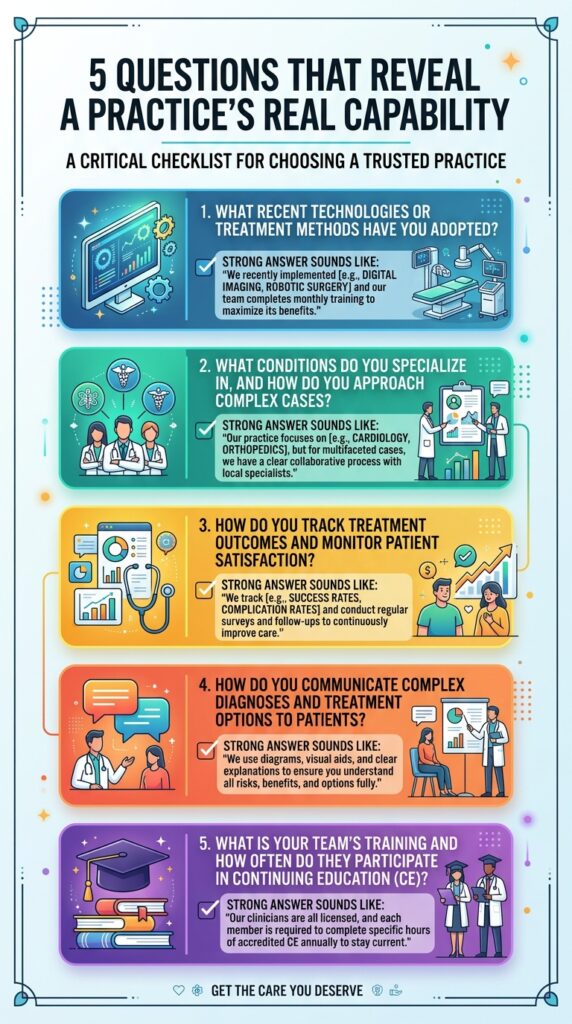
A short list of questions cuts through the marketing. Before you commit to a practice, find out:
- Surgery: Do you perform surgery on-site, and what range of procedures do you handle?
- Diagnostics: Do you run bloodwork and other diagnostics in your own lab, or send samples out?
- Anesthesia: What patient monitoring do you use during procedures?
- Imaging: Do you have digital X-ray and other imaging on-site?
- Inpatient: Can you hospitalize a pet for the day if it needs observation or fluids?
- Referrals: What happens when a case exceeds your scope, and who do you refer to?
The answers reveal far more than the word on the sign. A facility that can confidently walk you through its surgical, diagnostic, and monitoring capabilities is telling you it can manage the unexpected. One that hesitates, or refers out for anything beyond the basics, is a fine choice for wellness care but a poor bet for a pet that may need more.
Accreditation is another useful shortcut. The American Animal Hospital Association evaluates practices against a long list of standards covering surgery, anesthesia, pain management, and record-keeping, and its accreditation program is voluntary. Fewer than 5,000 animal hospitals across the US and Canada hold it, and accredited practices are re-evaluated roughly every three years, so a practice that pursues accreditation is choosing to be measured against a higher bar than the legal minimum.
A Real Example: When Capability Mattered
Marcus T., a Sacramento resident near the Del Paso corridor, noticed his four-year-old Labrador, Cooper, straining and refusing food one afternoon. Cooper had a habit of eating things he should not, and Marcus suspected the worst. He called his usual practice, which handled vaccinations well but could not run diagnostics on-site and asked him to come back in two days.
Instead, Marcus brought Cooper to Del Paso Veterinary Clinic, a full-service facility. The team examined Cooper, ran bloodwork in their own lab within the hour, and took digital X-rays that revealed a partial obstruction from a swallowed toy fragment. Because the practice had a surgical suite and anesthetic monitoring in-house, they could stabilize Cooper, complete the pre-anesthetic workup, and schedule surgery without shipping him to an unfamiliar facility. Cooper came through the procedure well and went home the next day.
Marcus’s takeaway was simple. The difference between the two practices was not the sign out front. It was that one could see inside Cooper, act on what it found, and operate all in the same building. That capability, not the label, is what he now looks for.
Matching the Right Care to Your Pet’s Situation
None of this means every pet needs the most advanced facility for every visit. A young, healthy animal getting routine shots is well served by a good outpatient practice, and continuity with a team that knows your pet matters enormously. The question is whether the practice can scale up when your pet’s needs do.
The smartest approach is to choose a primary practice that covers the full range under one roof, so a routine wellness visit and a sudden problem land in the same trusted hands with the same records. When a sick pet needs to be seen quickly, a practice that offers a same-day vet appointment and can diagnose and treat on-site removes the scramble of finding capable care mid-crisis. Deciding in advance, while your pet is healthy, means you are never choosing a facility under pressure and hoping the label matches the capability.
Frequently Asked Questions
-
Is an animal hospital better than a veterinary clinic?
Not automatically. The terms are not strictly regulated, so a clinic may offer full hospital-level services while a hospital keeps a narrow scope. What matters is capability, whether the practice has an on-site surgical suite, in-house lab, anesthesia monitoring, and imaging. Judge a facility by what it can actually do for your pet rather than the word on its sign, and match that capability to your animal’s real needs.
-
What services should a full-service animal hospital in Sacramento offer?
A full-service facility typically provides preventive and wellness care, vaccinations, in-house diagnostics and bloodwork, digital imaging, dentistry, and surgery with proper anesthetic monitoring. Many also hospitalize patients for observation or fluids during the day. The key is that these capabilities live under one roof, so a routine visit and a more serious problem can be handled by the same team with your pet’s complete history on hand.
-
Does the difference between a hospital and clinic affect cost?
This guide focuses on capability rather than cost, but broadly, facilities with more equipment and on-site services can often resolve a problem in a single visit instead of referring you elsewhere. The real value is in speed and continuity: diagnosing and treating in the same building saves time when your pet is unwell. Always discuss what a specific visit will involve directly with the practice.
-
Can a veterinary clinic perform surgery?
Some can and some cannot, which is why the name alone is not a reliable guide. A practice with a dedicated surgical suite, sterile instrumentation, and anesthetic monitoring can perform procedures in-house, from routine spays to foreign-body removal. A basic outpatient clinic may refer surgical cases elsewhere. Always ask directly what procedures a facility performs on-site and how it staffs and monitors its operating room before you assume.
-
Why does in-house diagnostic capability matter?
When a pet is sick, waiting days for outside lab results can delay treatment at the worst time. A facility with its own laboratory and imaging can run bloodwork and X-rays during the visit and act on the findings the same day. That speed often changes outcomes, letting a veterinarian catch infections, organ changes, or obstructions early, while there is still time to intervene effectively and start a concrete treatment plan.
-
How do I choose between animal hospitals near me?
Look past the label and compare capabilities. Ask each practice whether it performs surgery on-site, runs its own diagnostics, monitors anesthesia carefully, and has imaging available. Consider accreditation, continuity of care, and how clearly the team answers your questions. Choosing a full-service practice while your pet is healthy means you already have capable, familiar care in place when a routine visit turns into something more serious.
The sign on the building tells you what a practice is called; its capabilities tell you what it can actually do for your pet.