
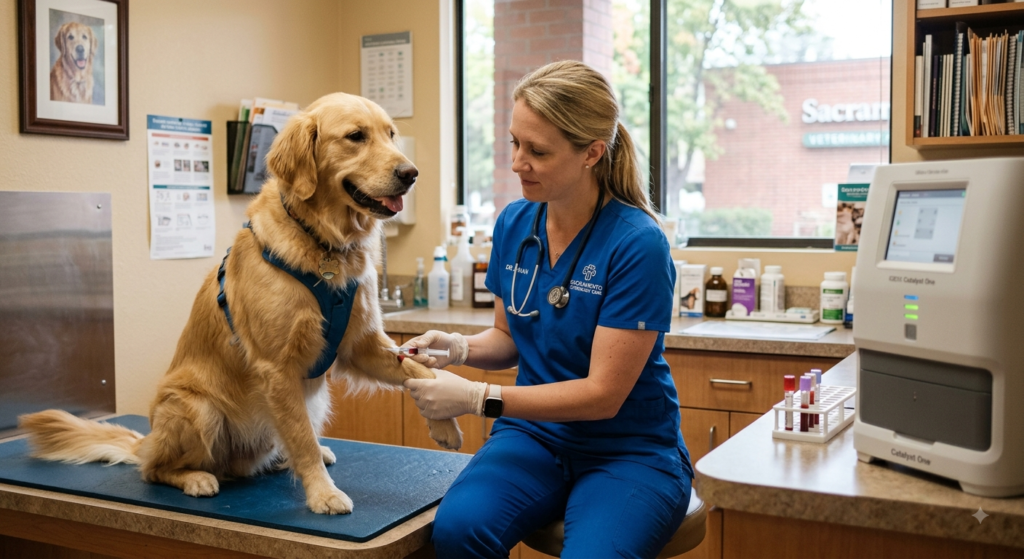
If you have ever typed “how much is a heartworm test” into Google right before a vet visit, you are not alone. It is one of the most common questions dog owners in the Sacramento area ask, especially heading into mosquito season. At Del Paso Veterinary Clinic, our in-house lab runs heartworm screening on dogs from Del Paso Heights, Natomas, and across the Sacramento region every week, and the cost question always comes with a bigger one underneath it: is this test actually necessary if my dog is already on prevention?
Short answer, yes. Here is the longer, more useful answer.
What a Heartworm Test Actually Checks For
A standard canine heartworm test is a blood screening that looks for heartworm antigen, a protein produced by adult female heartworms living inside a dog’s heart and pulmonary arteries. It is not a symptom check. Dogs infected with heartworm often show no outward signs at all until the disease has progressed, which is exactly why testing matters more than watching and waiting.
Most veterinary clinics, including ours, run this as an in-house test using a small blood draw. Results typically come back the same visit, so there is no waiting days for a lab to call back. Some clinics pair the antigen test with a microfilaria check, which looks for immature heartworm larvae circulating in the bloodstream. The American Heartworm Society now recommends running both together, since a dog can occasionally test negative on one and positive on the other, and combining them catches more true infections.
What Actually Affects How Much a Heartworm Test Costs
There is no single number that applies to every dog or every clinic, and any website that quotes one flat price without seeing your pet is oversimplifying it. A few real factors shape the cost of heartworm testing:
- Standalone test versus wellness visit. Testing on its own, during a dedicated screening appointment, is priced differently than when it is bundled into an annual wellness exam that already includes bloodwork.
- Antigen-only versus antigen plus microfilaria. A combined test that screens for both adult worms and larvae involves more lab work than a single antigen snap test.
- In-house versus send-out lab. In-house testing gives same-day answers. Send-out confirmatory testing, used mainly to verify an unexpected or borderline result, adds turnaround time and a separate lab fee.
- New patient exam requirements. If your dog has never been seen at the clinic, an exam is usually required alongside testing so the veterinarian can evaluate overall health before starting or renewing a prevention plan.
- Additional diagnostics. If a dog shows a cough, exercise intolerance, or weight loss, the veterinarian may recommend chest X-rays or additional bloodwork alongside the heartworm test, which changes the total visit cost.
Because pricing depends on these variables, the most accurate way to get a real number for your dog is to call and ask what a current heartworm screening visit includes. What you can control right now is understanding why the test matters and how often your dog actually needs one, which is where most owners are genuinely underinformed.
How Often Dogs Actually Need Heartworm Testing
This is where a lot of pet owners lose the thread. Being on a monthly preventive does not mean testing becomes optional. According to the American Heartworm Society, all dogs should be tested annually for heartworm, and that holds true even for dogs who never miss a dose. Here is why annual testing still matters on a preventive:
- Preventive medications are highly effective, but not 100 percent effective in every real-world scenario.
- A dog can spit out a chewable tablet, vomit shortly after dosing, or rub off a topical application without an owner noticing.
- A missed or late monthly dose, even once, can create a window of exposure.
- Annual testing confirms the prevention plan is actually working, not just assumed to be working.
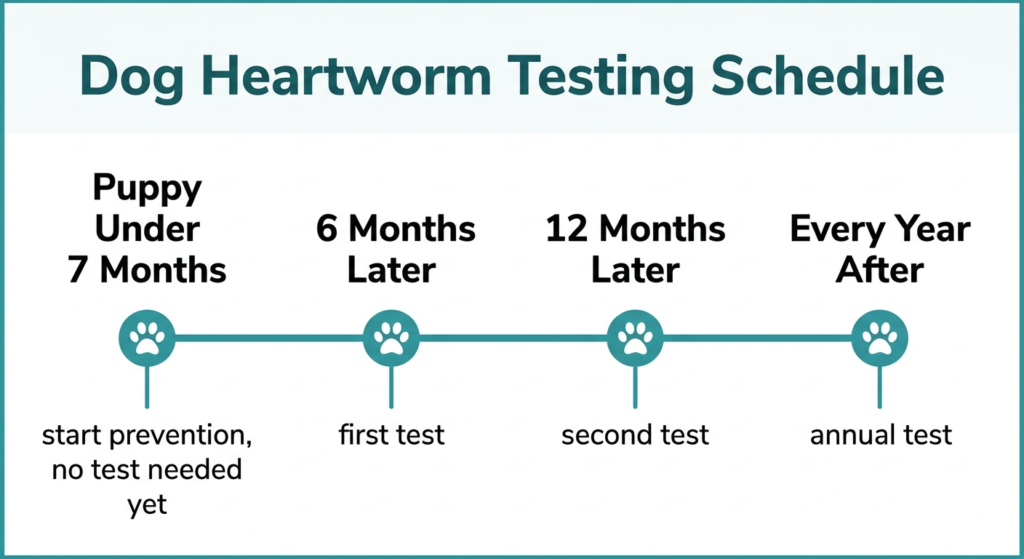
For puppies starting prevention under 7 months of age, a test is not required immediately since heartworm cannot be reliably detected that early. The Heartworm Society guidance is to start prevention, then test around 6 months later, again 6 months after that, and annually from then on. Adult dogs starting prevention for the first time need a baseline test before beginning, followed by the same 6-and-12-month recheck pattern.
If a dog has had a lapse in prevention, even one missed dose, testing should happen right away and again 6 months later, since it can take that long for an infection to become detectable in a blood sample.
Why Heartworm Testing Matters More in Sacramento Than Many Owners Assume
Heartworm has historically been thought of as a Southeast United States problem, and that reputation causes a real blind spot for Sacramento pet owners. It is outdated. The Companion Animal Parasite Council’s 2026 forecast specifically flags Northern California, including the Central Valley, as a region of increasing heartworm risk, driven by mosquito range expansion, warmer seasonal temperatures, and the movement of dogs between regions.
Sacramento’s climate plays directly into this. Long, warm seasons and a mild winter mean mosquitoes are active for a wider stretch of the year than most owners expect, and heartworm only needs a single infected mosquito bite to transmit. The idea that pets are “safe” once temperatures cool is not accurate here the way it might be in a colder climate. This is part of a broader national pattern; the American Veterinary Medical Association has reported that vector-borne disease risk, including heartworm, is expanding into regions that were never traditionally considered high-risk.
For dogs that travel with their owners, attend dog parks, spend time outdoors in Del Paso Heights or the river corridor, or live alongside other dogs with unknown prevention histories, annual testing is not a formality. It is the only way to know, rather than assume, that a dog is heartworm-free.
What Happens If a Dog Tests Positive
A positive result is not a reason to panic, and it does not mean the situation is unmanageable. It does mean next steps matter. A positive antigen test is typically followed by a confirmatory test to rule out a false positive, along with additional diagnostics such as chest X-rays or bloodwork to assess how far the infection has progressed and whether the heart and lungs have been affected. From there, your veterinarian builds a treatment plan and outlines an activity restriction period, since physical exertion can worsen complications while adult worms are being cleared. The earlier an infection is caught through routine annual testing, the more straightforward treatment tends to be.
Testing Timeline Comparison
| Dog’s Situation | When to Test | Why |
|---|---|---|
| Puppy under 7 months | No test needed yet; start prevention | Infection cannot be reliably detected this early |
| Puppy or new adult dog, 6 months into prevention | First heartworm test | Confirms prevention is working from the start |
| Adult dog on continuous prevention | Every 12 months | Confirms no infection slipped through despite prevention |
| Dog with a missed or late dose | Immediately, then again 6 months later | A lapse creates a real exposure window |
| Dog with unclear or unknown prevention history | As soon as possible | Establishes a health baseline before starting or restarting prevention |
A Recent Case at Our Clinic
One of our regular patients, a three-year-old Labrador mix named Duke from the Natomas area, came in for his routine annual wellness visit. His owner mentioned he had never missed a monthly chewable, so testing felt almost like a formality to her. His antigen test came back positive. A confirmatory send-out test verified the result, and chest X-rays showed the infection was still in an early stage with minimal lung changes. Because it was caught during a routine annual screening rather than after symptoms appeared, Duke’s treatment plan was far more straightforward than it would have been months later. His owner later admitted she almost skipped that year’s test since he “seemed fine.” That is exactly the assumption annual testing exists to correct, since heartworm disease frequently shows no outward symptoms until it has progressed significantly.
Prevention Is the Other Half of This Conversation
Testing tells you where things stand today. Prevention is what keeps that answer negative next year. Once a dog tests clear, staying on a veterinarian-recommended, year-round monthly preventive is the most effective way to avoid this conversation altogether. Our team can walk you through the right prevention product for your dog’s size, lifestyle, and health history as part of a wellness visit, and our on-site pharmacy makes it simple to start that same day rather than waiting on an outside order. If you want the fuller picture on fleas, ticks, and intestinal parasites alongside heartworm, our guide to year-round parasite prevention in Sacramento covers the complete seasonal picture.
Same-day in-house testing is available as part of our diagnostic lab services, so you are not left waiting on results before you can make a decision about your dog’s care.
Frequently Asked Questions
-
How much is a heartworm test for a dog?
Cost varies depending on whether it is a standalone antigen test, a combined antigen and microfilaria panel, and whether it is bundled with a wellness exam. New patients typically need an exam alongside testing. Because pricing depends on these factors and can change, the most reliable way to get an accurate figure for your dog is to call the clinic directly and describe your dog’s situation.
-
How much is heartworm testing if my dog is already on prevention?
Being on a monthly preventive does not change the recommended testing schedule. Annual testing is still advised even for dogs who never miss a dose, since no preventive is guaranteed 100 percent effective in every real-world scenario. The cost structure is generally the same as testing an unprotected dog, since it is based on the type of test run rather than the dog’s prevention status.
-
Is there a low cost heartworm test near me option in Sacramento?
Testing cost typically depends on whether it is a standalone screening or bundled into a wellness visit, along with whether a new patient exam is required. Call ahead and ask what a heartworm screening appointment includes so you can compare the actual scope of testing being offered, not just a quoted number without context.
-
How often should my dog get tested for heartworm?
All dogs should be tested annually, according to American Heartworm Society guidelines. Puppies starting prevention under 7 months old do not need an immediate test but should be screened around 6 months later, again 6 months after that, and yearly from then on. Dogs with a missed or late dose should be tested right away and again 6 months later.
-
Can a dog test negative for heartworm and still be infected?
Yes, in some cases. It takes roughly 6 months after an infected mosquito bite for heartworm to become detectable in a blood test, so a dog tested too soon after exposure can show a false negative. This is part of why the recommended 6-and-12-month retesting pattern exists for new patients and puppies starting prevention.
-
Why does my Sacramento dog need heartworm testing if heartworm is more common in the Southeast?
Heartworm risk has been expanding into regions not historically considered high-risk, including the Central Valley and Northern California, according to recent parasite forecasting data. Sacramento’s long mosquito season and mild winters mean exposure risk exists across more of the year than many owners assume, making annual testing relevant here rather than optional.
A ten-minute blood draw today is a far easier conversation than a treatment plan six months from now, and that trade-off is really what the test is for.