
If you have searched “does coconut oil kill fleas” after finding your dog scratching nonstop, you have probably landed on a dozen blogs that all say something slightly different. At Del Paso Veterinary Clinic, our team fields this exact question constantly, especially during the warmer stretch of the year when Sacramento’s flea population is at its worst. So we pulled the actual research, not just the internet folklore, and here is what it really shows.
The short version: coconut oil is not the flea solution most pet owners hope it is, but the reason why is more interesting than a flat yes or no.
The Short Answer
Straight coconut oil, scooped from the jar and rubbed into your pet’s coat, does not reliably kill an existing flea population, and it does nothing to the flea eggs and larvae already living in your carpet, bedding, and yard. It may offer a mild, short-lived repellent effect, but that is a very different claim than “kills fleas,” and the difference matters if your pet is currently infested.
This is not us being dismissive of natural remedies. It is what the actual entomology research says, and the nuance behind it explains why so many pet owners feel like coconut oil “sort of” worked and then didn’t.
What Lauric Acid Actually Does
Nearly every article claiming coconut oil kills fleas points to lauric acid, a fatty acid that makes up close to half of coconut oil’s composition. That part is accurate. Where the claims go sideways is in how lauric acid actually behaves.
A widely cited 2018 study from the USDA’s Agricultural Research Service, published in the journal Scientific Reports, tested repellent activity against ticks, biting flies, bed bugs, and mosquitoes. The researchers found that raw coconut oil itself showed essentially no repellency in lab testing. What worked was a blend of isolated medium-chain fatty acids, including lauric acid, that had been chemically freed from the oil’s triglyceride structure through a process called hydrolysis. In the lead researcher’s own words, coconut oil itself is not a repellent.
That is the detail almost every “coconut oil kills fleas” article leaves out. The compound that performed well in testing was a processed extract, not a spoonful of oil from your pantry. It is also worth noting directly: this study tested ticks, mosquitoes, biting flies, and bed bugs, not fleas specifically, so even the promising data does not translate into a confirmed flea claim.
Can Coconut Oil Kill Fleas Already on Your Pet?
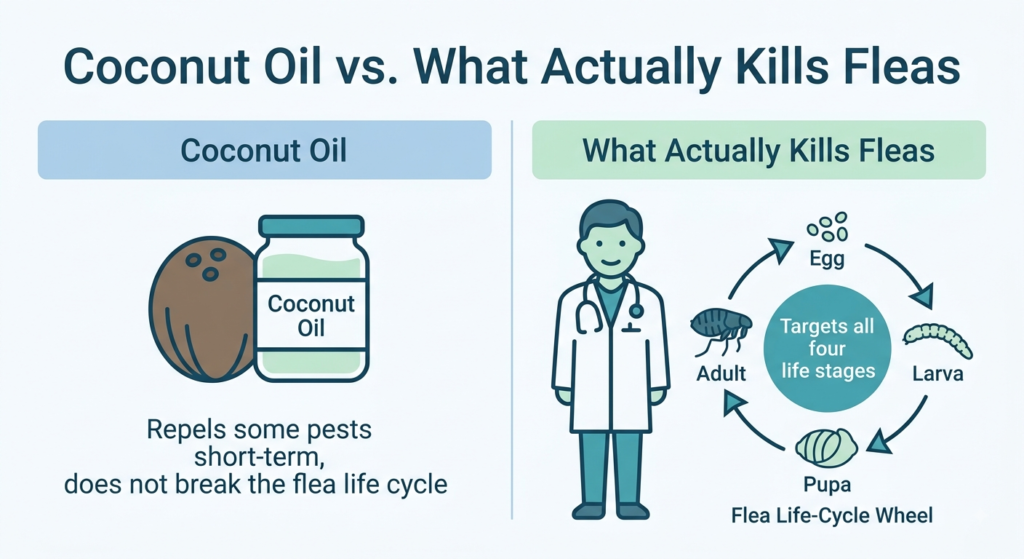
Here is where a grain of truth exists. Any thick oil, coconut oil included, can physically coat and suffocate a small number of adult fleas it comes into direct contact with, the same way dish soap does in a flea bath. That is a mechanical effect, not a chemical kill, and it only reaches the fleas the oil physically touches at that moment.
It will not reach:
- Flea eggs, which fall off your pet constantly and scatter through carpets, furniture, and bedding
- Larvae developing in those same environments
- Pupae, which can stay dormant and protected for weeks or months
- New adult fleas hatching days or weeks after you treated the coat
Since a flea infestation is rarely just “the fleas on the pet,” treating only the animal with a substance that cannot touch eggs or larvae leaves the infestation’s foundation completely intact.
Will Coconut Oil Kill Fleas in the Home Environment?
No, and this is arguably the more important gap. Roughly 95 percent of a flea population at any given time exists as eggs, larvae, and pupae in the environment, not as adult fleas on your pet. Coconut oil applied to a dog or cat’s coat has zero contact with that environmental population. A homeowner who relies on coconut oil alone will often see fleas seem to improve for a few days as the visible adults die off or move away, only to watch the infestation rebound within one to two weeks as the next generation of eggs matures into adults.
Does Coconut Oil Get Rid of Fleas Long-Term?
Based on the available evidence, no. Even the more optimistic research on coconut-derived repellents describes protection windows measured in days to about a week for ticks, using processed fatty acid extracts rather than raw oil. Nothing in the literature supports a claim of sustained, long-term flea elimination from coconut oil use, whether applied topically or fed to a pet.
Why This Matters More in Sacramento (and California Generally)
California’s climate is part of what makes this myth genuinely risky rather than just mildly ineffective. Sacramento’s long warm season, combined with mild winters that rarely include a hard freeze, means flea populations do not get the seasonal die-off that colder regions experience. The Companion Animal Parasite Council specifically recommends year-round flea control for dogs and cats for exactly this reason, noting that fleas are the most common external parasite veterinarians see in practice.
The same climate logic applies further south. Pet owners searching for solutions to fleas in San Diego are dealing with an even milder, more consistently warm coastal climate, one that supports flea activity essentially year-round with almost no seasonal break at all. Whether you are in Sacramento’s Central Valley heat or San Diego’s coastal warmth, the underlying problem is the same: a mild California climate gives fleas far more opportunity than pet owners in harsher climates ever have to deal with, which is exactly why a repellent-only approach tends to fail here specifically.
Coconut Oil vs. Actual Flea Control
| Factor | Coconut Oil | Veterinarian-Recommended Flea Control |
|---|---|---|
| Kills adult fleas on contact | Limited, mechanical only | Yes, targeted and consistent |
| Affects flea eggs | No | Yes, many products include growth regulators |
| Affects flea larvae/pupae | No | Yes, with appropriate products |
| Breaks the full life cycle | No | Yes |
| Duration of protection | Days at most, if any | Weeks to a month, product dependent |
| Backed by flea-specific research | No direct flea studies | Yes, extensively studied and regulated |
| Suitable as sole treatment for an infestation | No | Yes, when used as directed |
A Recent Case at Our Clinic
A Sacramento client brought in her cat, Biscuit, after weeks of trying a coconut oil regimen recommended by a friend. She had been rubbing it into his coat every few days and was frustrated that he was still scratching and had started developing small scabs along his lower back. On exam, Biscuit had a moderate flea infestation along with early signs of flea allergy dermatitis, an itchy skin reaction some pets develop from flea saliva. His owner was genuinely surprised, since she had been “treating” him consistently the whole time. Once we explained that the oil was never addressing the eggs and larvae cycling through her home, and started Biscuit on an appropriate veterinary flea control plan alongside environmental treatment, his scratching noticeably improved within about two weeks, and the skin lesions began healing shortly after.
What Actually Works
The most effective approach, and the one reflected in CAPC’s guidelines, combines three things: a veterinarian-recommended flea product used consistently and year-round, environmental treatment of carpets, bedding, and yard areas during an active infestation, and treatment of every pet in the household at the same time, since fleas move freely between animals. Our team can help build a prevention plan that fits your pet’s age, health history, and lifestyle as part of our parasite prevention and control services.
If your pet’s scratching has already led to raw patches, hair loss, or skin infection the way Biscuit’s did, that is a separate problem that needs its own attention. Our guide on dog skin conditions in Sacramento covers allergies, hot spots, and when it is time to see a vet dermatologist rather than manage it at home.
Frequently Asked Questions
-
Does coconut oil kill fleas?
Not reliably. Research shows raw coconut oil itself has little to no proven repellent or insecticidal effect. The isolated fatty acids inside it, once chemically processed, have shown some repellent activity against other pests like ticks and mosquitoes in lab studies, but that is a different product than oil from a jar, and no flea-specific research supports a “kills fleas” claim.
-
Can coconut oil kill fleas that are already on my dog?
It may kill a small number of fleas it physically coats through simple suffocation, similar to any thick oil or soap. It cannot reach flea eggs, larvae, or pupae living in your home, which make up the vast majority of an infestation. That gap is why pet owners often see temporary improvement that does not last.
-
Does coconut oil get rid of fleas completely?
No. Even under the most favorable interpretation of the available research, coconut oil does not address the flea life cycle stages happening off your pet. A true infestation typically requires a combination of pet-applied treatment and environmental control to fully resolve.
-
Will coconut oil kill fleas eggs or larvae?
No. There is no evidence that coconut oil affects flea eggs or larvae, which develop in carpets, furniture, bedding, and yards rather than on the pet itself. This is one of the main reasons a coconut-oil-only approach tends to fail against an established infestation.
-
Why are fleas such a problem in Sacramento specifically?
Sacramento’s warm, extended flea season and mild winters mean the population rarely experiences the natural seasonal die-off that colder regions get. This is consistent with guidance from parasite control organizations recommending year-round prevention in this kind of climate, rather than seasonal treatment.
-
Is coconut oil safe to use on my pet even if it doesn’t kill fleas?
In small, appropriate amounts, coconut oil is generally considered low risk for topical use on healthy pets and is sometimes used for coat conditioning. It should not, however, be relied on as a pet’s only flea protection. If your pet has current flea exposure or skin irritation, it is worth having a veterinarian evaluate what is actually going on before assuming a home remedy has it covered.
A jar of coconut oil might make your dog’s coat shine, but it will not out-work the flea life cycle happening in your carpet, and knowing that difference early saves weeks of frustration.