Parasite Prevention in Sacramento: A Pet Owner’s Guide to Fleas, Ticks, and Heartworms
There’s a rhythm to how parasite problems walk into our exam rooms. Early spring, we start seeing the first flea cases. By June, tick exposures climb. All summer and well into fall, mosquitoes are out, which means heartworm transmission is on the table. And because Sacramento’s winters are mild — we almost never get a hard, sustained freeze — the parasite calendar here doesn’t really shut off the way it does in colder parts of the country.
That’s the honest reason year-round parasite prevention in Sacramento isn’t overkill. It’s just the climate we live in. At Del Paso Veterinary Clinic, we routinely see owners who thought they could safely skip a few winter doses discover fleas in February or a positive heartworm test in May. This guide walks through what the common parasites are, how they affect dogs and cats, why Sacramento’s climate matters, and what a modern preventive plan actually looks like.
Why Parasite Prevention Matters More Than Pet Owners Realize
Most people think of parasites as a nuisance — itchy skin, the occasional tick pulled off a back after a hike. The reality is that parasites are disease vectors, and several of the ones endemic to Northern California carry serious, sometimes fatal, illnesses.
Fleas don’t just cause itching; they transmit tapeworms and the bacteria behind cat scratch disease, and in cats they’re a leading cause of severe anemia. Ticks carry Lyme disease, anaplasmosis, ehrlichiosis, and Rocky Mountain spotted fever. Heartworms — transmitted by a single infected mosquito bite — cause progressive, often irreversible, heart and lung damage. Intestinal parasites like roundworms and hookworms can be zoonotic, meaning they transmit to humans, particularly children.
The math works heavily in prevention’s favor. Monthly preventatives are among the most studied, safest, and most effective tools in veterinary medicine, and they’re dramatically cheaper than treating an established infection. The Companion Animal Parasite Council publishes regularly updated prevention guidelines that most modern clinics reference, and they’re unambiguous: year-round, broad-spectrum prevention is the standard of care.
Fleas — The Most Common Parasite We See
Fleas are the parasite most Sacramento pets will encounter, often repeatedly. A single adult flea can lay 50 eggs per day. Those eggs fall into carpets, bedding, yard soil, and upholstery, where they hatch and restart the cycle in as little as two weeks.
What Fleas Do
Active flea infestations cause intense itching, hair loss, and secondary skin infections. Some pets develop flea allergy dermatitis — a hypersensitivity where even one or two bites cause severe skin reactions. In young or small animals, heavy flea burdens can cause life-threatening anemia. Fleas also transmit tapeworms; if your pet swallows one while grooming, tapeworm segments appear in the stool a few weeks later.
Signs to Watch For
Scratching, chewing at the base of the tail, tiny dark specks in the coat (flea dirt), red bumps, and hair loss. Dragging the rear, visible tapeworm segments in stool, or a sudden increase in grooming all warrant a flea check.
Modern Flea Prevention
Monthly topical or oral preventatives have largely replaced flea collars and shampoos for routine prevention. Products like NexGard, Bravecto, Credelio, Frontline Plus, and Advantage II are selected based on the pet’s species, size, lifestyle, and any coexisting concerns. For multi-pet households, treating every pet — including indoor-only cats — is essential, because fleas brought in on one animal quickly spread to the others. Our parasite prevention and control program covers product selection, dosing, and seasonal adjustments.
Ticks — A Growing Concern in Northern California
Ticks used to be considered primarily a foothill and rural issue in our region. That’s changed. Warming temperatures, expanding wildlife populations, and an increase in dog-friendly outdoor recreation have brought tick exposures closer to urban Sacramento than they used to be.
Tick-Borne Diseases We See
Four diseases matter most in Northern California: Lyme disease (carried by the western black-legged tick), anaplasmosis, ehrlichiosis, and Rocky Mountain spotted fever. All are bacterial, all require antibiotic treatment, and all are much easier to prevent than to treat. Some — particularly untreated Lyme disease — cause long-term joint, kidney, and neurological problems.
How to Check Your Pet
After any outing in grassy, brushy, or wooded areas, run your hands slowly over your pet’s entire body. Check behind the ears, inside the ears, between toes, under the collar, in the armpits, around the tail base, and along the belly. Ticks prefer warm, hidden spots. A tick that’s been attached for fewer than 24 hours is much less likely to transmit disease than one that’s been feeding for two days.
Proper Tick Removal
Use fine-tipped tweezers, grasp the tick as close to the skin as possible, and pull straight out with steady pressure. Don’t twist, burn, or smother it. Save the tick in a sealed bag or jar in case your veterinarian wants to identify it. Clean the bite site with rubbing alcohol or soap and water.
Tick Prevention Products
Oral preventatives like Bravecto, NexGard, and Simparica kill ticks before they can transmit disease. Topical products like K9 Advantix II add repellent action. For high-exposure dogs — hikers, hunters, rural residents — combining oral prevention with a repellent collar or topical is a reasonable layered approach. Cats have a narrower list of safe options, so always use feline-specific products.
Heartworms — The Parasite Most Worth Preventing
If there’s one parasite worth every pet owner’s undivided attention, it’s the heartworm. Heartworm disease is transmitted by mosquitoes, and Sacramento has a long, humid mosquito season. A single infected mosquito bite deposits microscopic heartworm larvae under the skin, which migrate to the heart and pulmonary arteries over six months and mature into adult worms up to a foot long.
Why Heartworm Is Different
Treatment for an established heartworm infection is expensive, painful, and takes months. Dogs undergoing treatment require strict cage rest, because worm die-off can cause fatal pulmonary embolism. There is no approved treatment for heartworm in cats — prevention is the only option. The American Heartworm Society recommends year-round prevention combined with annual screening for every dog in the United States, and they’re specific that California is an endemic area.
How Heartworm Prevention Works
Monthly preventatives — Heartgard Plus, Interceptor Plus, Trifexis, Simparica Trio, Advantage Multi, and others — kill heartworm larvae deposited in the previous 30 days before they can mature. Missing doses, even by a few days, creates windows where larvae can mature past the stage preventatives work on. Annual testing is recommended even for pets on consistent prevention, because prevention protocols don’t work if the pet was already infected when started.
Heartworm Testing
The standard in-clinic heartworm snap test uses a few drops of blood and returns results in about 8 minutes. Comprehensive testing is available through our in-house diagnostics and lab, and we usually pair heartworm screening with a full wellness panel once yearly.
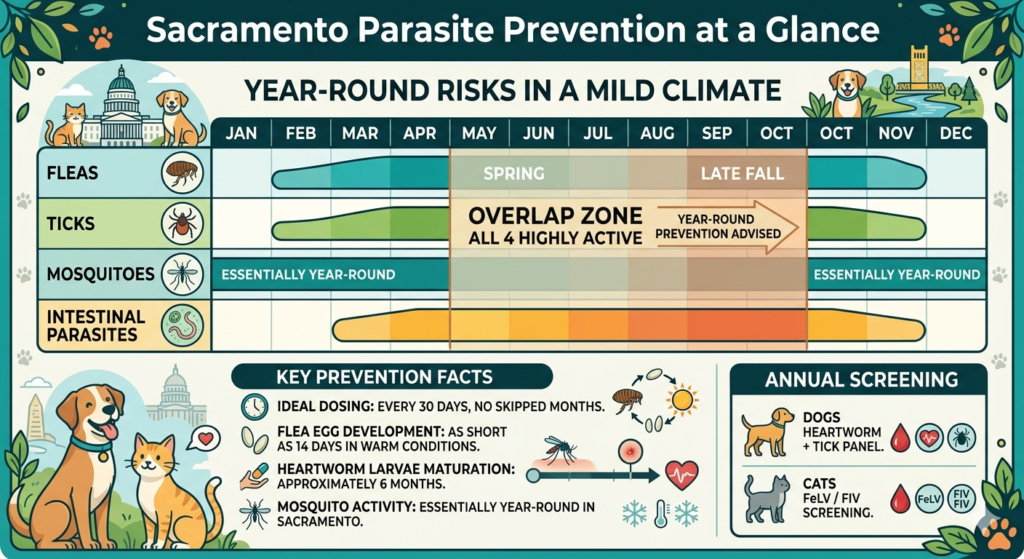
Sacramento Parasite Prevention at a Glance
Mosquito activity: essentially year-round in Sacramento due to mild winters
Flea egg development time: as short as 14 days in warm conditions
Heartworm larvae maturation time: approximately 6 months
Ideal dosing: every 30 days, no skipped months
Annual screening: heartworm test + tick panel for dogs, FeLV/FIV for cats
Intestinal Parasites and Other Common Threats
Beyond fleas, ticks, and heartworms, a thorough parasite prevention plan addresses the parasites that live inside the pet.
Roundworms are common in puppies and kittens, transmitted from the mother, and shed through feces. They can also infect humans, particularly children, making routine fecal testing and deworming important public health practices.
Hookworms feed on blood in the intestinal tract. Heavy infections cause anemia, dark stools, weight loss, and in young animals, serious illness. They also transmit through skin contact with contaminated soil.
Whipworms are harder to detect and cause chronic diarrhea, often with mucus or blood.
Tapeworms enter through fleas or occasionally prey animals. Visible segments — they look like grains of rice — near the tail or in stool are the most common sign.
Giardia is a protozoan parasite picked up from contaminated water sources. It causes chronic, sometimes intermittent diarrhea and requires specific treatment.
Annual fecal testing is recommended for all pets. Most modern monthly preventatives combine intestinal parasite coverage with flea, tick, or heartworm protection, which simplifies the protocol dramatically.
Building a Parasite Prevention Plan for Your Pet
A good prevention plan is tailored, not cookie-cutter. Here are the factors we walk through with Sacramento pet owners.
Lifestyle and Exposure
A dog that hikes in the Sierra foothills every weekend needs different coverage than a small indoor dog that goes out only on a leash. Cats that go outdoors, even briefly, face meaningful flea and tick exposure. Multi-pet households need every pet covered because parasites don’t stay on the first animal they find.
Species and Size
Cats tolerate fewer chemical classes than dogs. Products safe for dogs can be fatal to cats — pyrethrin-based products are the most notorious example. Size dictates dosing. Never split or combine products.
Age and Health Status
Puppies and kittens have their own dosing considerations. Pregnant or nursing pets, pets on immunosuppressive medication, and pets with certain genetic sensitivities (MDR1 mutations in collie-breed dogs, for instance) need specific product selection.
Concurrent Conditions
Pets with food allergies, epilepsy, or chronic skin disease sometimes need specific product choices. A good veterinarian factors these in.
Every new patient gets a tailored plan during their pet wellness exam, and plans are reviewed annually or whenever the pet’s lifestyle changes.
Ranger’s Story — Why Year-Round Prevention Matters
Ranger, a five-year-old Australian Shepherd, came to us last spring because his owner wanted to start him on heartworm prevention “before summer.” Routine screening, run through our in-house lab, came back heartworm-positive.
The owner was shocked. Ranger lived primarily indoors, only went on neighborhood walks, and had been “mostly” on prevention the year before. Looking back, there had been a stretch of three months the previous fall when doses had been skipped during a move. That was the window.
Treatment took eight months, required strict activity restriction, and was uncomfortable for Ranger throughout. A year later, he’s doing well and back on monthly prevention without a missed dose. The owner is now, understandably, evangelical about year-round dosing.
The lesson isn’t that Ranger did anything unusual. It’s that prevention gaps — even short ones — in an endemic area like Sacramento can have real consequences.
Flea & Tick Prevention Products — A Practical Comparison
Pet owners often ask how the product categories compare. Here’s a plain-language breakdown:
No single category is best for every pet. The right choice depends on your pet’s tolerance, your household routine, exposure level, and budget. A veterinarian’s role is to match product to patient, not to push a single brand.
Home and Yard Parasite Prevention Beyond Medication
Medication is the primary tool, but environmental management supports it.
Keep grass trimmed short, remove leaf litter where ticks and mosquitoes harbor, eliminate standing water, and wash pet bedding weekly in hot water during active seasons. Vacuuming carpets, rugs, and upholstery breaks the flea life cycle by removing eggs and larvae before they hatch. For yards with heavy parasite pressure, professional pest control can be a reasonable addition — just confirm any products used are pet-safe.
Yes. Fleas ride in on shoes, clothing, and other pets. Mosquitoes carrying heartworm enter through open doors and windows. Indoor-only cats regularly test positive for fleas, and heartworm has been documented in cats with zero outdoor exposure. Indoor pets may have lower overall risk, but “lower” isn’t “zero” — especially in a mild-winter region like Sacramento. Every pet in the household should be on appropriate prevention year-round, because parasites don’t recognize walls or window screens.
Why do vets recommend year-round prevention if winters are mild?
Sacramento’s winters rarely produce the sustained freezing temperatures that interrupt flea, tick, and mosquito life cycles in colder parts of the country. Fleas and mosquitoes remain active in warm microclimates — garages, crawlspaces, sheltered yards — even during cooler months. Gaps in prevention create windows where parasites can establish infection before the next dose takes effect. The safest, simplest, and most effective approach is uninterrupted monthly dosing with no seasonal breaks.
Can I use the same flea and tick product on my dog and cat?
No. Several chemicals safe for dogs are highly toxic to cats, particularly permethrin and other pyrethrins found in many canine topical products and collars. Cat exposure to these — including indirect exposure from grooming a dog that was recently treated — can cause severe neurological symptoms and death. Always use species-specific, veterinarian-recommended products. Read labels carefully. When treating multiple pets, keep recently treated dogs separated from cats until the product has fully dried and absorbed.
How often should my pet be tested for heartworm?
The American Heartworm Society recommends annual heartworm testing for every dog, including those on consistent monthly prevention. Annual testing catches the rare case where a dose was missed or a product failed, and also confirms prevention is working before the next year’s prescription is renewed. For cats, testing is less routine but recommended when symptoms suggest heartworm disease or when starting prevention. The in-clinic snap test uses a small blood sample and returns results in minutes during the same visit.
Are monthly parasite preventatives safe for long-term use?
Yes, for the vast majority of pets. Modern preventatives have been extensively tested and used safely in millions of animals for years. Adverse reactions exist but are uncommon, and specific risk factors — certain breeds, concurrent medications, existing health conditions — are well known to veterinarians. A pre-prescription exam helps identify pets that need alternative product selection. Reactions are more often mild and product-specific, resolved by switching to a different preventative rather than stopping prevention entirely.
What should I do if I find a tick on my pet?
Remove it as soon as possible using fine-tipped tweezers, grasping the tick close to the skin and pulling straight out with steady pressure. Don’t twist, burn, or apply substances to it. Clean the bite area with rubbing alcohol or soap and water. Save the tick in a sealed container for identification if needed. Monitor the bite site for 2 to 4 weeks for redness, swelling, or a rash, and watch your pet for lethargy, fever, lameness, or appetite changes. Contact a veterinarian if anything looks concerning.
The best parasite prevention is the kind you never have to think about again — a consistent monthly routine, tailored to your pet, that quietly keeps fleas, ticks, and heartworms from ever becoming a problem in the first place.