
Most conversations about dog vaccinations stop at rabies, and it makes sense why. It is the one shot California law requires, so it gets all the attention. But rabies is only one line item on a much longer list of diseases that dogs and cats in Sacramento are realistically exposed to every year. Bordetella, leptospirosis, canine influenza, and feline leukemia virus rarely make it into the conversation, yet they are responsible for a steady stream of preventable illness at Del Paso Veterinary Clinic and clinics across the Central Valley. This guide walks through what each of these vaccines actually protects against, which pets genuinely need them, and how California’s rabies law fits into the bigger picture of a complete vaccination plan.
California’s Rabies Law, Briefly
Before getting into the lesser-known vaccines, it helps to understand the one legal requirement that anchors everything else. Under California Health and Safety Code Section 121690, every dog must be vaccinated against rabies once it reaches three months of age, with a booster given one year after the first dose and revaccination every three years after that. Only three-year labeled rabies vaccines are approved for dogs in California, even for that first dose. Cats are not subject to a statewide rabies mandate, though several counties and cities layer on their own local ordinances, so it is worth checking with local animal control if a cat spends time outdoors.
The rabies requirement exists because the entire state is officially declared a rabies area, meaning bats, skunks, and other wildlife carriers are present everywhere, not just in rural pockets. That single legal obligation is the floor, not the ceiling, of a responsible vaccination plan. Everything below it is where lifestyle actually starts to matter.
Core Versus Lifestyle Vaccines
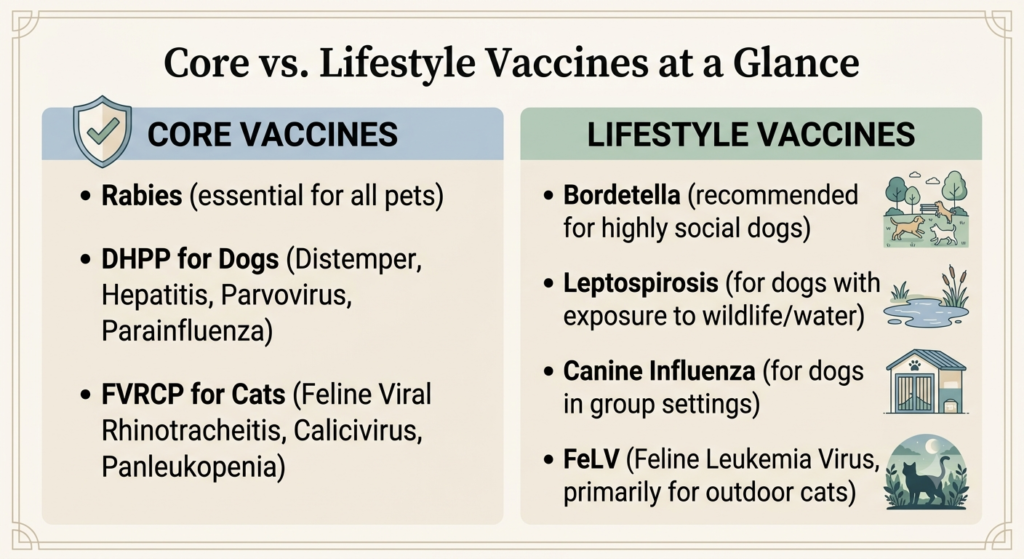
Veterinary organizations split vaccines into two categories. Core vaccines, including distemper, parvovirus, adenovirus, and rabies for dogs, and FVRCP and rabies for cats, are recommended for essentially every patient regardless of how they live. Lifestyle vaccines are recommended selectively, based on where a pet goes, who it interacts with, and what it is exposed to in the environment.
This is the distinction most pet owners miss. A dog that never leaves a fenced backyard has a very different risk profile than a dog that visits dog parks along the American River every weekend, and their vaccine plans should not look identical. The American Veterinary Medical Association notes that bordetella and canine influenza vaccines are specifically recommended for dogs that spend time in places where other dogs congregate, such as boarding facilities, daycare, and training classes.
Bordetella: The Social Dog’s Vaccine
Bordetella bronchiseptica is one of the primary bacteria behind kennel cough, a persistent, honking cough that spreads easily through airborne droplets in enclosed or crowded spaces. It is rarely life-threatening on its own, but it is miserable for the dog and highly contagious to every other dog nearby.
Dogs that visit groomers, boarding kennels, dog daycare, training classes, or off-leash parks are the ones who need this vaccine most. Sacramento has no shortage of these environments, from dog parks in Land Park and Natomas to the boarding and daycare facilities that fill up around holidays. Most boarding and daycare facilities require proof of a current bordetella vaccine before admission, which makes this one of the more practical, day-to-day vaccine decisions a dog owner will make.
Leptospirosis: Why It’s Now Treated as Core
Leptospirosis used to sit firmly in the lifestyle category, recommended mainly for dogs that hike, hunt, or swim. That has changed. The 2022 AAHA Canine Vaccination Guidelines were updated in 2024 to reclassify leptospirosis as a core vaccine recommendation for most dogs, reflecting a documented rise in cases nationwide, including in dogs with no rural or outdoor lifestyle at all.
Leptospirosis is a bacterial infection spread through water and soil contaminated by the urine of infected wildlife, including raccoons, skunks, and rodents that are common throughout Sacramento County. Sacramento’s irrigation canals, standing puddles after winter rain, and the American and Sacramento Rivers all create the kind of environment where leptospira bacteria can survive. A dog does not need to swim in a river to be exposed; drinking from a puddle on a neighborhood walk is enough. Leptospirosis is also zoonotic, meaning it can pass from dogs to the people who care for them, which is part of why AAHA’s task force pointed to increasing prevalence as the reason for the update. For pet owners managing year-round parasite and disease exposure in the Sacramento Valley climate, our parasite prevention guide covers the related risks tied to standing water and wildlife contact in more depth.
Canine Influenza: The Newer Threat in Group Settings
Canine influenza (H3N2 and H3N8 strains) is a relatively recent addition to the vaccine conversation, and it behaves a lot like bordetella in terms of who needs it. It spreads through respiratory droplets and contaminated surfaces in group settings, meaning boarding facilities, dog shows, grooming salons, and daycare are the highest-risk environments.
Symptoms range from a mild cough and nasal discharge to more severe respiratory illness in a smaller percentage of dogs. Because canine influenza outbreaks tend to travel with dogs that move between regions, cities, or events, a dog that boards regularly or travels with its owner is a stronger candidate for this vaccine than a dog that mostly stays close to home. This is a conversation worth having during a wellness visit rather than assuming every dog needs it automatically.
Feline Leukemia Virus: Protecting Outdoor and Multi-Cat Households
Feline leukemia virus, or FeLV, is a cat-specific disease transmitted through close contact, including mutual grooming, shared food bowls, and bite wounds. It weakens the immune system over time and is one of the leading infectious causes of death in cats.
The FeLV vaccine is now considered core for kittens by many veterinary organizations, since exposure risk is hard to predict before a cat’s adult lifestyle is established. For adult cats, it shifts toward a lifestyle-based recommendation: cats that go outdoors, live in multi-cat households, or have contact with cats of unknown FeLV status are the strongest candidates for ongoing protection. A 2024 update to WSAVA’s Global Vaccination Guidelines specifically recommends FeLV as core for young cats and for adult cats with outdoor access, even in homes where the cat is not fully outdoor, since indoor and outdoor exposure can blur in practice.
Comparing the Vaccines: Who Actually Needs What
| Vaccine | Species | Category | Protects Against | Best Fit For | Typical Booster |
|---|---|---|---|---|---|
| Rabies | Dogs & Cats | Core (required for dogs) | Rabies virus | All dogs by law; all cats recommended | Every 1 or 3 years |
| DHPP | Dogs | Core | Distemper, hepatitis, parainfluenza, parvovirus | All dogs | Every 3 years after puppy series |
| FVRCP | Cats | Core | Feline viral rhinotracheitis, calicivirus, panleukopenia | All cats | Every 3 years after kitten series |
| Bordetella | Dogs | Lifestyle | Kennel cough | Dogs in daycare, boarding, grooming, dog parks | Annually or per facility requirement |
| Leptospirosis | Dogs | Now treated as core by AAHA | Leptospira bacteria | Nearly all dogs with any outdoor access | Annually |
| Canine Influenza | Dogs | Lifestyle | H3N2/H3N8 flu strains | Dogs that board, travel, or attend group events | Annually |
| FeLV | Cats | Core for kittens, lifestyle for adults | Feline leukemia virus | Kittens; outdoor or multi-cat adult cats | Annually for at-risk cats |
A Sacramento Case Study: When “Just the Core Shots” Wasn’t Enough
A three-year-old Labrador mix named Bear had always been current on his rabies and DHPP vaccines, and his owner assumed that covered everything. Bear’s routine changed when his family started using a dog daycare in North Sacramento twice a week while they returned to in-office work. Within a month, Bear developed a persistent, dry cough that sounded almost like he was choking on something.
At his exam, there was no fever and no nasal discharge, just the characteristic honking cough consistent with kennel cough. Because Bear had never received a bordetella vaccine, he had no protection against the strain circulating through the daycare. Treatment was straightforward and he recovered within two weeks, but the daycare temporarily suspended his enrollment until a bordetella vaccine was on file, which is standard practice at most facilities. His case is a common one: a healthy, fully core-vaccinated dog whose new lifestyle quietly outpaced his old vaccine plan. It is a good example of why a wellness exam paired with vaccinations works better than a vaccine visit alone, since a lifestyle change like a new daycare schedule is exactly the kind of detail that reshapes a vaccination plan.
Building a Plan That Actually Fits Your Pet’s Life
There is no universal vaccine schedule that works for every dog or cat, and pretending otherwise is how gaps in protection happen. A few questions worth asking at your pet’s next visit:
- Does my dog visit dog parks, daycare, boarding, or grooming facilities regularly?
- Does my dog walk near irrigation ditches, puddles, or the river, or spend time where wildlife is common?
- Is my cat ever outdoors, even briefly, or does it live with a cat that goes outside?
- Has my pet’s routine changed recently in a way that increases exposure to other animals?
These answers, discussed with a veterinarian familiar with your pet’s health history, are what actually shape a sound lifestyle-based vaccine plan, rather than defaulting to either “just the legal minimum” or “every vaccine available.”
Frequently Asked Questions
-
Is the rabies vaccine the only one required by law for dogs in California?
Yes. Rabies is the only vaccine mandated by California state law for dogs, required at three months of age with a booster at one year and revaccination every three years after that. Cats are not subject to a statewide rabies requirement, though some cities and counties have their own local ordinances. Every other vaccine, including bordetella, leptospirosis, canine influenza, and FeLV, is a medical recommendation based on lifestyle rather than a legal obligation, which is why these decisions vary from pet to pet.
-
My dog only goes to the dog park occasionally. Does he still need the bordetella vaccine?
Even occasional exposure can be enough, since kennel cough spreads quickly through shared air space and surfaces. Many boarding and daycare facilities also require proof of a current bordetella vaccine before admission, regardless of how often a dog actually visits. If your dog goes to any group setting, even infrequently, it is worth discussing bordetella at your next visit rather than waiting until a specific trip requires it.
-
Why is leptospirosis suddenly being recommended for dogs that don’t hike or swim?
Veterinary guidelines shifted because case data showed leptospirosis infections increasing in dogs with no obvious outdoor or rural lifestyle. The bacteria spreads through water and soil contaminated by wildlife urine, which means a dog drinking from a puddle on a routine neighborhood walk can be exposed. Sacramento’s irrigation canals and seasonal standing water make this a relevant risk for most local dogs, not just ones with rugged outdoor routines.
-
Does my indoor cat really need the FeLV vaccine?
It depends on true exposure risk rather than the “indoor” label alone. Cats that occasionally slip outside, live with another cat that goes outdoors, or have an uncertain history before adoption are reasonable candidates. Fully indoor cats in single-cat households with no outdoor exposure typically have lower priority for ongoing FeLV boosters, but it is worth confirming kitten-stage vaccination status, since FeLV is commonly given as part of the core kitten series.
-
Can my dog get all of these vaccines in one visit?
In most cases, yes, a veterinarian can administer multiple vaccines during a single wellness visit, spacing certain combinations if needed based on your pet’s health and vaccine history. This is one of the advantages of pairing vaccinations with a full physical exam rather than a vaccine-only visit, since it gives your veterinarian the full picture needed to build an appropriate combined schedule.
-
Where can I get these vaccines for my dog or cat in Sacramento?
Del Paso Veterinary Clinic offers a walk-in vaccine clinic for both dogs and cats, covering core and lifestyle vaccines including bordetella, leptospirosis, canine influenza, and feline leukemia. Puppies and kittens starting their vaccine series can also reference our first-year vaccination guide for a full schedule breakdown by age.
A vaccine plan built around your pet’s actual routine, not just the legal minimum, is one of the simplest ways to keep them out of the exam room for the wrong reasons.