

There is a particular sound every Sacramento dog owner eventually learns to recognize — the rhythmic thump of a back leg working overtime against a flank, or the wet, repetitive licking of a paw at two in the morning. Dog skin conditions are by far the most common reason pets walk through our doors, and Sacramento’s specific climate, vegetation, and year-round flea pressure mean local dogs deal with skin issues that owners in other parts of the country simply do not see at the same intensity. At Del Paso Veterinary Clinic, our team has been treating itchy, scratchy, miserable dogs since 1940, and we have learned that getting the right diagnosis the first time is the single biggest factor in whether a dog ends up comfortable for life or stuck in a years-long cycle of flare-ups.
This guide walks through the most common skin problems we see in Sacramento dogs, what triggers them locally (oak pollen, foxtails, summer dust, and that mild winter that lets fleas thrive in December), how vets actually diagnose what is going on, what treatments work in 2026, and when home care is no longer enough. We have included a real case study from our practice, a comparison table of common conditions, and answers to the questions Sacramento owners ask most.
Local data point worth knowing: A 2023 dataset from veterinary insurance claims showed that allergic skin disease consistently ranked among the top three most-claimed dog health issues in California. In Sacramento specifically, oak pollen counts and the long warm season push environmental allergy cases into a near year-round pattern instead of a clean spring-and-fall window.
Why Sacramento Dogs Are Especially Vulnerable to Skin Problems
The Central Valley is a beautiful place to live with a dog. It is also, if you happen to be a dog, a perfect storm of environmental triggers that human owners rarely notice.
Oak pollen drifts heavily across the region from late winter through spring, and many dogs are sensitive to it the same way some people are. Unlike humans, dogs do not usually sneeze through pollen exposure — they absorb it through their skin, which is why itchy paws and belly rashes spike during March and April.
Grass and weed allergens dominate from late spring through fall. Bermuda grass, ryegrass, and various weeds in our region produce pollens that cling to fur during walks. Dogs who roll in the grass or sleep on outdoor lawns are essentially marinating in allergens.
Foxtails are the regional villain that out-of-state owners often have never heard of. These barbed grass seeds detach from dried-out grasses in summer, lodge into paws, ears, eyes, and noses, and migrate inward causing painful infections. Sacramento has heavy foxtail pressure from May through October.
Year-round fleas. Our mild winters mean fleas never fully die off. A dog with even a mild flea allergy can be miserable in January here, when owners assume “flea season” is over.
Dry summer air and dust. Sacramento summers pull moisture out of skin barriers. Dogs with any preexisting sensitivity often see flare-ups simply because the protective skin barrier becomes more permeable.
The Most Common Dog Skin Conditions We See in Sacramento
Here are the conditions we diagnose most often in our exam rooms, in roughly the order of frequency.
Atopic Dermatitis (Environmental Allergies)
This is the big one. Canine atopic dermatitis (CAD) is a genetic predisposition to overreact to environmental allergens — pollens, dust mites, mold spores, grass. Affected dogs typically start showing signs between one and three years of age. The classic pattern is itchy paws (especially licking the front paws), itchy belly, recurring ear infections, and rubbing the face on furniture or carpet. According to research summarized by the Cornell University College of Veterinary Medicine, atopic dermatitis affects an estimated 10 to 15 percent of all dogs and is one of the most-studied conditions in veterinary medicine.
Flea Allergy Dermatitis (FAD)
FAD is not the same as a dog with fleas. It is a dog whose immune system is hypersensitive to flea saliva — meaning a single bite can trigger weeks of intense itching. The classic presentation is itching and hair loss along the lower back, base of the tail, and inner thighs. Many Sacramento owners insist their dog “doesn’t have fleas” because they do not see any, but with FAD, the fleas only need to bite once and jump off. We solve a lot of mystery itching simply by getting dogs onto consistent year-round flea prevention through our parasite prevention and flea control program.
Food Allergies and Sensitivities
Less common than people think — true food allergies probably account for 10 to 20 percent of allergic skin cases at most. The hallmark is itching that is not seasonal (year-round, no clear pattern), often paired with chronic ear infections and sometimes loose stools. Diagnosis requires a strict 8 to 12 week elimination diet trial, which is harder than it sounds because a single treat or table scrap restarts the clock.
Hot Spots (Acute Moist Dermatitis)
Hot spots appear suddenly — usually a red, oozing, hairless patch your dog could not stop licking or chewing. They develop fast (sometimes overnight) and almost always trace back to an underlying trigger: a flea bite, an allergic flare, matted fur trapping moisture, or even a scratch from rough play. Thick-coated breeds like Golden Retrievers, Labradors, and German Shepherds get them more often, especially in our humid summer afternoons.
Yeast and Bacterial Infections
These rarely appear out of nowhere. A dog with chronic yeast in the ears or between the toes almost always has an underlying allergy compromising the skin barrier first. The yeast or bacteria are opportunists. Treating the infection without addressing the underlying cause guarantees the problem comes back, which is why our diagnostic workup looks for both layers.
Mange (Demodex and Sarcoptes)
Two very different mites. Demodex is non-contagious and often shows up in puppies or immunocompromised adults as patchy hair loss without much itching. Sarcoptic mange (scabies) is contagious between dogs and to humans, and the itching is intense — affected dogs scratch themselves raw. Both are diagnosed with skin scrapings, which we run in our in-house diagnostic lab for same-day results.
Foxtail Injuries
Not technically a skin condition, but every Sacramento vet has a folder full of foxtail stories. The seed lodges between toes, in ear canals, in nostrils, in armpits — and because the barbs only allow forward movement, it migrates inward over days or weeks. The result is a painful abscess, infection, or in worst cases, a foxtail that has tracked into the chest or abdomen.
How to Tell If Your Dog’s Itching Is Serious
Some scratching is normal. The following signs mean it is time to schedule an appointment rather than wait it out:
- Itching that disrupts sleep (yours or your dog’s)
- Hair loss in patches or symmetrical patterns
- Open sores, scabs, or oozing areas
- Strong odor from the skin or ears
- Repeated head shaking or ear scratching
- Constant paw licking that has stained the fur brown
- Skin that feels thickened, leathery, or darkened
- Any skin issue that has lasted more than two weeks
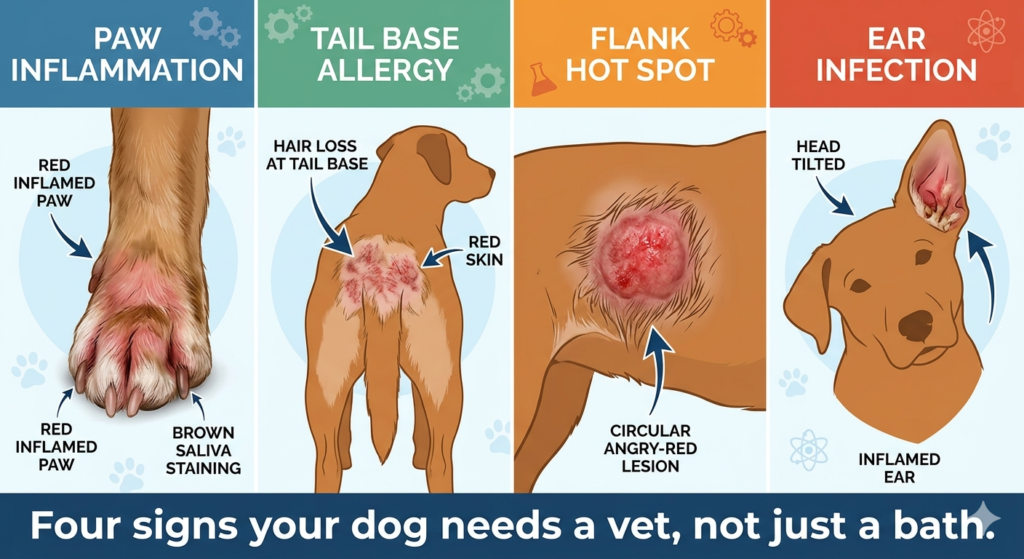
Photo-rich infographic prompt: A four-panel comparison illustration showing common warning signs on a dog silhouette: (1) red inflamed paw with brown saliva staining, (2) hair loss at the base of the tail with red skin, (3) hot spot on the flank as a circular angry-red lesion, (4) head tilted with clearly inflamed ear. Caption beneath: “Four signs your dog needs a vet, not just a bath.”
A Real Sacramento Case: Riley’s Foxtail Summer
Riley is a six-year-old Australian Shepherd whose family lives near a popular hiking trail in the Sacramento foothills. In July 2024, his owner noticed Riley was holding up his right front paw on walks. By the time they brought him in, two days later, the paw was visibly swollen, hot to the touch, and Riley flinched when anyone tried to handle the webbing between his toes.
The exam revealed a small puncture between the toes with a tract of inflamed tissue running upward. Skin cytology showed a heavy bacterial infection. We sedated Riley, explored the puncture, and removed an intact foxtail seed almost two centimeters long. He went home with antibiotics, anti-inflammatories, and an e-collar for ten days.
What turned Riley’s case from a footnote into a teaching moment was what we found at his recheck: a second, smaller foxtail under his ear flap that had not yet caused symptoms. His owner had never thought to check there. We now hand every Sacramento client a one-page foxtail check guide for summer months, and Riley’s family has made post-walk inspections part of their daily routine. He has not had a foxtail incident since.
How Vets Diagnose Dog Skin Conditions
Owners are often surprised by how methodical a good dermatology workup is. A skin condition that “just looks like allergies” can have three or four overlapping causes, and missing any of them means the dog stays uncomfortable.
The standard sequence looks like this:
- Detailed history — when symptoms started, seasonal patterns, current diet, flea prevention status, other pets in the home, previous treatments tried
- Physical exam — distribution of lesions matters enormously; itching on the paws and face suggests atopy, while itching on the lower back suggests fleas
- Skin scraping — checks for mange mites under the microscope
- Cytology — a slide of skin or ear material reveals bacteria, yeast, or inflammatory cells
- Tape preparation — surface yeast and bacteria evaluation
- Fungal culture — when ringworm is suspected, especially in puppies or households with kids
- Diet trial — the gold standard for food allergy diagnosis
- Allergy testing — blood-based or intradermal, used when immunotherapy is being considered
Most of these tests have same-day results when run in-clinic, which means treatment can start the same visit instead of waiting a week for outside lab work.
Comparison: Common Dog Skin Conditions at a Glance
| Condition | Typical Signs | Distribution | Itch Level | Diagnosis | Sacramento Triggers |
|---|---|---|---|---|---|
| Atopic dermatitis | Paw licking, belly rash, ear infections | Paws, belly, face, ears | High | History + ruling out other causes | Oak pollen, grasses, dust mites |
| Flea allergy dermatitis | Hair loss, scabs at tail base | Lower back, tail, thighs | Severe | Visual + flea check | Year-round flea pressure |
| Food allergy | Year-round itching, ear infections, GI signs | Variable; often ears + paws | Moderate-high | 8-12 week diet trial | Not seasonal |
| Hot spot | Sudden red oozing patch | Single localized area | Severe | Visual exam | Heat, humidity, matted coat |
| Yeast infection | Greasy skin, smell, brown ears | Ears, paws, skin folds | Moderate | Cytology | Secondary to allergies |
| Sarcoptic mange | Intense itching, crusts on edges of ears | Ears, elbows, belly | Extreme | Skin scraping | Contact with infected wildlife |
| Foxtail injury | Sudden limp, head shake, swelling | Paws, ears, nose, eyes | Painful | Visual + exploration | May–October trail exposure |
Treatment Options in 2026: What Actually Works
Veterinary dermatology has changed enormously in the last decade. The old default of long-term steroids has largely been replaced by safer, more targeted options.
- Apoquel (oclacitinib) — daily oral medication that blocks specific itch pathways; works within hours and is generally safe for long-term use
- Cytopoint — an injectable monoclonal antibody specifically targeting the itch signal IL-31; one shot lasts four to eight weeks
- Allergen-specific immunotherapy (allergy shots) — the closest thing to a long-term solution for atopic dogs; based on individual allergy testing and customized to the dog’s specific triggers, given as drops or injections over months
- Medicated shampoos and topical mousses — chlorhexidine, miconazole, and oatmeal-based products that calm skin and reduce surface infection
- Omega-3 fatty acid supplements — improve skin barrier function over weeks to months
- Targeted antibiotics or antifungals — only when cytology confirms infection; not routine
- Diet management — prescription hydrolyzed or novel-protein diets for confirmed food allergies
Sacramento owners specifically searching for “allergy shot for dogs near me” are usually thinking of Cytopoint injections, immunotherapy, or both. The right choice depends on whether the goal is fast symptomatic relief (Cytopoint) or long-term immune retraining (immunotherapy).
Home Care That Actually Helps
A few practical things owners can do between vet visits:
- Wipe paws and belly with a damp cloth after every walk during pollen season
- Bathe weekly with a vet-recommended shampoo during flare-ups (more often dries the skin)
- Keep flea prevention going through every month of the year, not just summer
- Vacuum and wash bedding weekly to reduce dust mite exposure
- Check paws, ears, and armpits daily during foxtail season (May through October)
- Keep grooming current — matted coat traps moisture and bacteria
For dogs with established allergic conditions, routine wellness exam visits twice a year often catch flare-ups before they spiral into expensive infections.
When to See a Vet for Your Dog’s Skin
Call the clinic when itching has lasted more than two weeks despite home care, when you see open sores or lesions, when ear infections have come back for the second or third time, when hair loss is spreading, or when your dog seems genuinely uncomfortable. Schedule the same day if you suspect a foxtail, see a hot spot forming, or notice rapid swelling.
You can reach our team at (916) 925-2107 or visit us at 924 Del Paso Blvd, Sacramento, CA 95815.
Frequently Asked Questions About Dog Skin Conditions
-
What are the most common dog skin conditions in Sacramento?
The five we see most often are environmental allergies (atopic dermatitis), flea allergy dermatitis, hot spots, yeast or bacterial secondary infections, and foxtail injuries during summer. Sacramento’s combination of oak pollen, year-round flea pressure, dry summer air, and grass exposure means most local dogs end up dealing with at least one of these during their lifetime. Identifying the underlying trigger is more important than treating the surface symptoms alone.
-
How can I tell if my dog has allergies versus an infection?
Allergies typically cause widespread itching and recurring patterns — often seasonal or affecting paws, belly, and ears together. Infections produce specific lesions like pustules, crusts, or strong odor and may not be as itchy. The reality is many dogs have both at once, with allergies damaging the skin barrier and bacteria or yeast moving in afterward. A cytology slide takes about ten minutes and tells the difference clearly.
-
Where can I find pet dermatology in Sacramento?
Sacramento has several options for pet dermatology, ranging from general practices that handle dermatology cases internally to specialty referral hospitals. For most chronic skin issues, a general veterinary practice with strong dermatology experience and on-site diagnostic equipment can manage the case fully. Referral to a board-certified veterinary dermatologist is reserved for cases that fail standard treatment or require advanced testing like intradermal allergy panels.
-
Are allergy shots available for dogs near me in the Sacramento area?
Yes. Two main options exist locally: Cytopoint injections, which are monoclonal antibody shots that block itch signals for four to eight weeks, and allergen-specific immunotherapy, which is a customized vaccine series based on your dog’s individual allergy testing. Cytopoint is faster and easier; immunotherapy is slower but addresses the underlying immune dysregulation. Many Sacramento dogs do well on a combination during the transition period.
-
What causes hot spots on dogs?
Hot spots almost always start with an underlying irritation — a flea bite, an allergic flare, a small wound, matted fur trapping moisture, or persistent licking from a separate problem. The dog scratches or chews the area, breaks the skin barrier, and within hours bacteria multiply on the wet surface. The result is a painful, oozing lesion that grows quickly. Treatment requires clipping the fur, cleaning the area, and identifying what triggered the scratching in the first place.
-
When should I take my dog to a vet for skin issues?
Schedule an appointment when itching has lasted longer than two weeks, when you see open sores or oozing areas, when hair loss is spreading or appearing in patches, when your dog has had two or more ear infections in a year, or when home care has not helped. Same-day care is worth pursuing if you suspect a foxtail, see a rapidly growing hot spot, or notice swelling, severe pain, or your dog seems systemically unwell.
-
Can dog skin conditions be cured permanently?
Some can. Bacterial infections, yeast infections, mange, ringworm, and foxtail injuries are typically curable with appropriate treatment. Atopic dermatitis and food allergies are usually managed long-term rather than cured outright, since the underlying immune predisposition remains. The goal of modern dermatology is sustained comfort with the lowest medication load possible — many well-managed allergic dogs go years between meaningful flare-ups.
-
What is the difference between FAD and atopic dermatitis?
Flea allergy dermatitis is a hypersensitivity to flea saliva — even a single bite triggers weeks of itching, mainly affecting the lower back, tail base, and inner thighs. Atopic dermatitis is a genetic immune predisposition to react to environmental allergens like pollen, grasses, and dust mites, typically affecting the paws, belly, face, and ears. Many dogs unfortunately have both, which is why thorough diagnostic workup matters before settling on a treatment plan.
Itching is the language dogs use to tell us something underneath the surface is not working — and the sooner we listen, the sooner the scratching stops.