
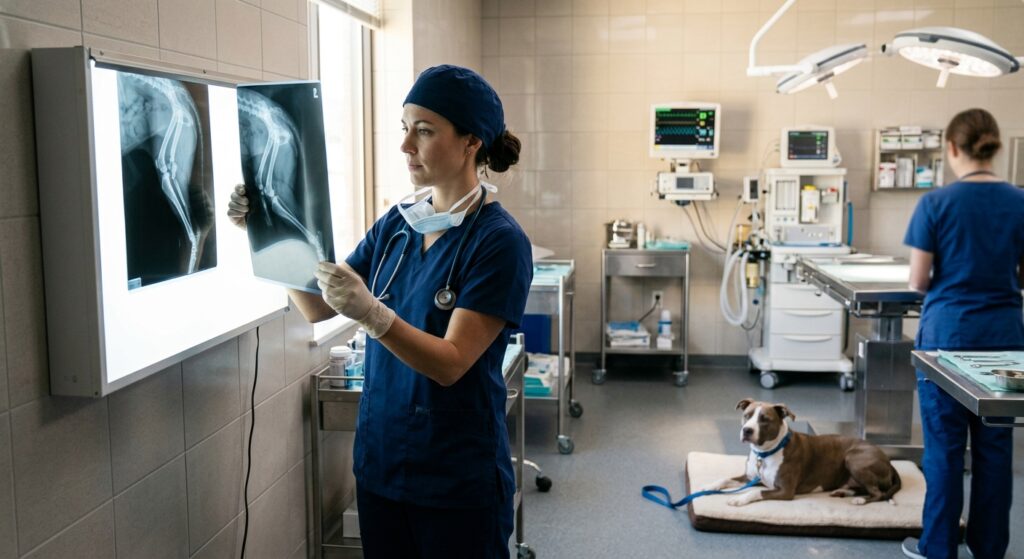
Searching for dog orthopedic surgery near me usually starts with a dog who suddenly won’t put weight on a back leg, or one who’s been favoring a limb for weeks and isn’t improving. Del Paso Veterinary Clinic handles orthopedic cases in-house rather than referring every knee or fracture case out to a specialty hospital, which matters because it means diagnosis, surgery, and recovery follow-up can all happen with the same team that already knows your dog.
This guide covers the most common orthopedic conditions in dogs, what TPLO surgery actually involves, how recovery timelines typically break down week by week, and what else falls under the same surgical program.
Common Orthopedic Conditions in Dogs
Most orthopedic surgery cases in dogs fall into a handful of recognizable categories, though the specifics vary by breed, age, and how the injury happened.
CCL/ACL Tears
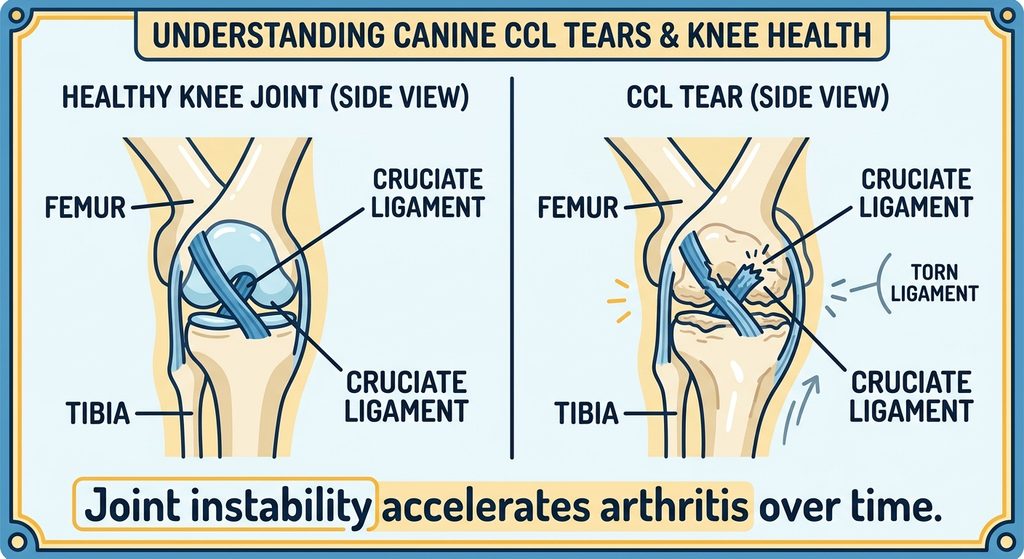
The cranial cruciate ligament, called the CCL in dogs and the equivalent of the ACL in people, stabilizes the knee joint. Unlike human ACL tears, which usually result from a sudden traumatic event, canine CCL injuries more often develop gradually as the ligament weakens over time, eventually tearing during ordinary activity like running or jumping. Large and giant breeds are disproportionately affected, and a dog who tears one CCL has a meaningfully elevated risk of tearing the other knee’s ligament later.
Luxating Patella
A luxating patella occurs when the kneecap slips out of its normal groove, which can range from an occasional, low-grade slip to a persistent dislocation that causes visible lameness. This condition is especially common in small and toy breeds, though it can appear in dogs of any size, and it sometimes occurs alongside a CCL tear in the same joint.
Other Orthopedic Injuries
Fractures from falls, being struck by a vehicle, or other trauma make up another significant portion of orthopedic cases, along with developmental conditions like hip dysplasia that may eventually require surgical management as a dog ages.
Why Untreated Orthopedic Injuries Get Worse
A dog who is “toe-touching” or limping on a leg is not just uncomfortable in the moment. Joint instability from an untreated CCL tear or unaddressed luxating patella accelerates wear inside the joint, and that wear does not reverse on its own.
Osteoarthritis is far more common in dogs than most owners realize, and according to the American Veterinary Medical Association, osteoarthritis pain in dogs often starts far earlier than owners assume, since dogs are skilled at adapting their posture and gait to compensate for joint pain long before it becomes obvious. Left unaddressed, an unstable joint speeds up this process considerably. The American Animal Hospital Association estimates that roughly one in five dogs will be diagnosed with osteoarthritis at some point in their lifetime, and untreated orthopedic injuries are a direct contributor to that number.
TPLO and Other Surgical Options for CCL Tears
Once a CCL tear is confirmed through exam and imaging, several surgical approaches exist, and which one fits best depends on the dog’s size, activity level, and the surgeon’s assessment.
TPLO (Tibial Plateau Leveling Osteotomy)
TPLO involves cutting and rotating the top of the tibia to change the geometry of the knee joint, effectively eliminating the joint’s reliance on the torn ligament rather than repairing or replacing it. This approach is most commonly recommended for medium to large, active dogs and has a strong track record for returning dogs to normal limb function.
Extracapsular Repair
For smaller dogs or less active patients, an extracapsular repair may be recommended instead. This technique stabilizes the joint from outside the joint capsule using a strong suture material, and it’s generally considered less invasive than TPLO, though outcomes can vary more by patient size than with TPLO.
Which technique is right for a given dog is a conversation between the owner and the surgical team, based on the dog’s weight, age, activity level, and the specifics of the tear.
What to Expect: Surgery Day and Anesthesia Safety
Orthopedic procedures require general anesthesia, and modern veterinary anesthesia protocols are built around minimizing risk at every stage. The AAHA Anesthesia and Monitoring Guidelines for Dogs and Cats emphasize that safe anesthesia is a continuum of care that starts before a patient ever arrives and continues through recovery at home, not just the time a dog is unconscious. In practice, this means a thorough preanesthetic exam, bloodwork to check organ function, continuous monitoring throughout the procedure, and a structured recovery period before a dog goes home.
Recovery Timelines After Orthopedic Surgery
Recovery from orthopedic surgery is gradual, and rushing activity too early is one of the most common causes of complications.
| Timeframe | What’s Typical |
|---|---|
| Days 1 to 3 | Rest, pain management, minimal weight-bearing, strict confinement |
| Weeks 1 to 2 | Short, controlled leash walks only, incision monitoring |
| Weeks 3 to 6 | Gradual increase in controlled activity as directed by the surgical team |
| Weeks 6 to 8 | Recheck exam and imaging to assess healing progress |
| Months 3 to 4 | Most dogs return to normal activity, pending full clearance |
Every dog heals at a different pace, and these ranges are general guidance rather than a guarantee. Following activity restrictions closely, even when a dog seems to feel fine, is one of the biggest factors in a smooth recovery.
In-House Orthopedic Surgery vs Referral
Many general practices diagnose orthopedic conditions but refer the actual surgery out to a specialty hospital, which adds an extra transition and often a longer wait.
| Factor | In-House Surgery | Referral to Specialty Hospital |
|---|---|---|
| Continuity of care | Same team for diagnosis, surgery, and follow-up | New team unfamiliar with the dog’s history |
| Scheduling | Often faster, fewer handoffs | Additional wait for specialist availability |
| Follow-up visits | With the veterinarian who knows the dog | May require travel back to the specialty hospital |
| Familiar environment | Dog is already comfortable at the clinic | New facility, new smells, more stress for some dogs |
This continuity is part of why Del Paso Veterinary Clinic keeps orthopedic cases in-house rather than defaulting to referral for every case.
Other Surgical Services Beyond Orthopedics
The same surgical program that handles orthopedic cases also covers other procedures, including tumor removal and cesarean sections for dogs experiencing dystocia during labor. Owners searching for veterinary surgery generally, not just orthopedic care specifically, are often looking for a single trusted surgical team rather than being referred to a different facility for every type of procedure.
Case Study: Bailey’s TPLO Recovery
Bailey, a five-year-old Labrador from the Natomas area, came in after suddenly refusing to bear weight on her right hind leg following a game of fetch in the backyard. Exam findings and a positive drawer sign confirmed a CCL tear, and given her size and activity level, TPLO was recommended.
Surgery went smoothly, and Bailey’s owner followed the recovery plan closely, including the strict early confinement that Bailey, an energetic dog, found frustrating. By week six, her recheck showed good healing progress, and by month three she was back to normal walks. Her owner later noted that the hardest part wasn’t the surgery itself but sticking to the activity restrictions in the first few weeks, which the surgical team had flagged as the single biggest factor in a smooth outcome.
Where to Start in Sacramento
If your dog is limping, favoring a leg, or has stopped bearing weight normally, the first step is an exam to determine whether the issue is orthopedic and what treatment path fits. Del Paso Veterinary Clinic’s dog orthopedic surgery near me program covers diagnosis, surgery, and recovery follow-up under one team.
For injuries that happen suddenly, such as a dog who won’t walk after an accident or a fall, animal surgery near me urgent evaluation is available to assess the injury and determine next steps quickly.
Frequently Asked Questions
-
How do I know if my dog needs orthopedic surgery or can heal with rest?
A veterinary exam, often including imaging, is the only reliable way to tell whether a leg injury needs surgical repair or can be managed conservatively. Partial CCL tears or mild patellar luxation sometimes respond to rest and physical therapy, while complete tears and more severe luxation typically do not stabilize without surgery. Waiting to find out usually allows more joint damage to accumulate, so an early exam is worth prioritizing.
-
What is TPLO surgery and how is it different from other CCL repairs?
TPLO changes the angle of the top of the tibia so the knee joint no longer depends on the torn cruciate ligament for stability, rather than repairing the ligament directly. It’s generally recommended for medium to large, active dogs and has strong long-term outcomes for returning dogs to normal function. Smaller or less active dogs may be better candidates for an extracapsular repair instead, depending on the surgeon’s assessment.
-
How long does recovery take after dog orthopedic surgery?
Most dogs progress through several recovery stages over roughly three to four months, starting with strict rest and confinement in the first weeks and gradually increasing controlled activity as healing is confirmed at recheck visits. Full return to normal activity typically isn’t cleared until imaging or exam findings support it. Following activity restrictions closely during early recovery has a major impact on the final outcome.
-
Do you handle tumor removal or C-section surgery, or only orthopedics?
The same surgical program that handles orthopedic procedures also covers other surgeries, including tumor removal and cesarean sections for dogs in labor difficulty. A veterinary exam determines the right approach for each specific case. Scheduling and next steps are discussed directly with the surgical team based on what’s found during evaluation.
-
Is anesthesia safe for older dogs needing orthopedic surgery?
Age alone does not rule out anesthesia, but it does mean a more thorough preanesthetic workup, including bloodwork to check organ function before any procedure. Modern anesthesia protocols are tailored to each patient’s individual health status rather than applying a single approach to every dog. A veterinarian can walk through the specific risk factors for an individual dog during a pre-surgical exam.
-
What happens if a CCL tear is left untreated?
An untreated CCL tear leaves the knee joint unstable, which accelerates wear and significantly increases the risk of early osteoarthritis in that joint. Dogs often compensate by shifting weight to other limbs, which can strain those joints over time. Surgical stabilization, when appropriate, is generally the most effective way to slow this progression and protect the joint’s long-term function.
A limping dog is rarely something that simply works itself out, and catching an orthopedic injury early tends to make the whole recovery easier, for the dog and the owner.